
What's Happening?
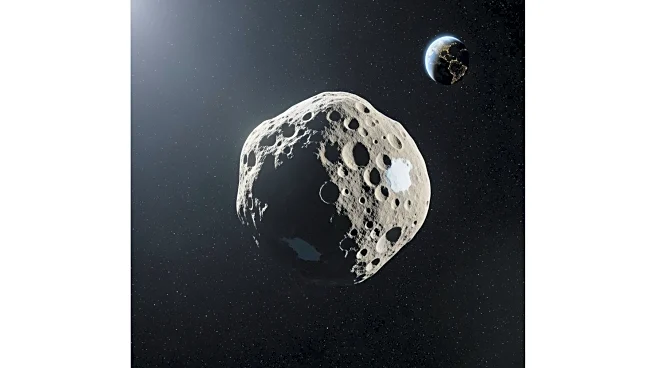
NASA is currently tracking an asteroid, designated as '2025 YH3', which is approximately the size of a bus and is traveling towards Earth at a speed exceeding 22,600 miles per hour. The asteroid is expected
to make its closest approach to Earth today, coming within 284,000 miles of the planet. This distance is considered cosmically close, yet it poses no immediate threat to Earth. In addition to 2025 YH3, NASA is also observing two other asteroids: '2025 YC3', which is about the size of a building, and another bus-sized asteroid, '2025 XT7'. These asteroids are expected to pass Earth at a distance of 2.4 million miles. NASA's Center for Near Earth Object Studies (CNEOS) is responsible for monitoring these near-Earth objects, which are remnants from the solar system's formation approximately 4.6 billion years ago.
Why It's Important?
The monitoring of near-Earth objects (NEOs) like 2025 YH3 is crucial for planetary defense and understanding potential threats from space. While the current asteroids pose no immediate danger, the tracking and study of such objects help scientists prepare for any future scenarios where an asteroid could pose a significant risk to Earth. The data collected by NASA aids in developing strategies to mitigate potential impacts, ensuring the safety of the planet. Additionally, the study of these objects provides valuable insights into the early solar system, contributing to scientific knowledge and exploration.
What's Next?
NASA will continue to monitor these and other near-Earth objects to assess any changes in their trajectories that could pose future risks. The agency's ongoing research and observation efforts are part of a broader initiative to enhance planetary defense capabilities. Future missions may involve more detailed studies of these asteroids, potentially including spacecraft visits to gather more data. Public awareness and education about these efforts are also likely to increase as NASA continues to share its findings and advancements in asteroid tracking technology.