







What's Happening?
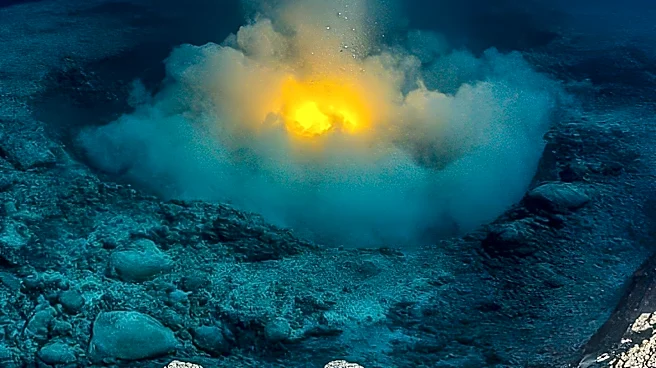
For the first time, scientists have observed the formation of a new section of Earth's oceanic crust. This groundbreaking event occurred at the Southeast Indian Ridge between Australia and Antarctica, where tectonic plates meet. Researchers from the French
National Center of Scientific Research deployed an underwater observatory to capture this rare phenomenon. The event involved a massive release of magma, which cooled and solidified to form new crust. This process, known as seafloor spreading, typically occurs in sudden, violent bursts rather than gradually. The observations provide new insights into tectonic activity and the formation of Earth's crust.
Why It's Important?
This discovery is significant as it offers a direct observation of a process that forms a substantial portion of Earth's surface. Understanding seafloor spreading is crucial for geophysicists as it sheds light on tectonic movements and the dynamics of Earth's crust. The ability to measure these events provides a new tool for scientists to study geological processes that were previously difficult to observe. This knowledge can improve models of tectonic activity, which are essential for predicting geological events and understanding the Earth's geological history.
What's Next?
The successful observation of this event opens new avenues for marine geophysics research. Scientists can now use these findings to refine seismic data models and better understand the mechanics of seafloor spreading. Future research will likely focus on deploying similar observatories in other tectonically active regions to capture more of these rare events. This could lead to a deeper understanding of the Earth's geological processes and contribute to advancements in earthquake prediction and natural disaster preparedness.