



What's Happening?
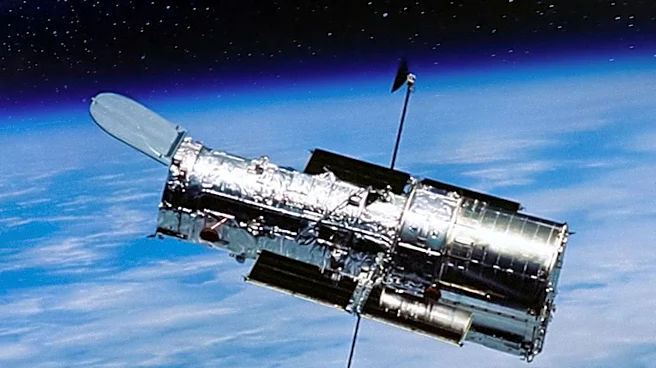
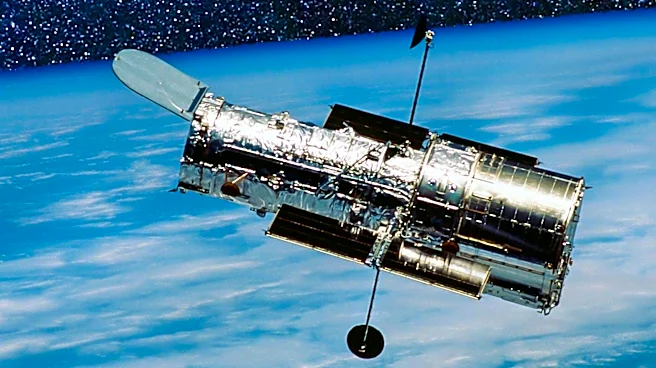
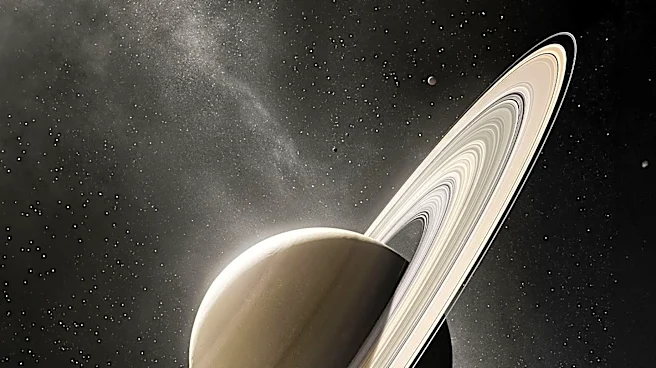
Astronomers utilizing images from NASA’s Hubble Space Telescope (HST) have identified a previously unobserved 10-sided wave pattern, or decagon, in Saturn's southern atmosphere. This discovery, detailed in a recent study published in Science Advances,
was made through data collected as part of Hubble’s Outer Planet Atmospheres Legacy (OPAL) program, which annually images outer planets to study their atmospheric compositions and evolution. The research also incorporated observations from ground-based telescopes, including the Calar Alto Observatory in Spain. Unlike Saturn's well-known northern hexagonal atmospheric structure, which remains largely fixed, the newly found southern decagon exhibits an eastward migration and oscillates every 32 days, suggesting it behaves more like a meandering wave across multiple atmospheric layers. This feature was not observed by NASA’s Cassini spacecraft during its mission from 2004 to 2017, indicating it is a recent development.
Why It's Important?
The discovery of this dynamic decagon in Saturn's southern atmosphere provides crucial insights into planetary atmospheric behavior and dynamics, which can significantly advance our understanding of gas giants. The contrast between the fixed northern hexagon and the migrating southern decagon offers a unique opportunity to study how large-scale atmospheric patterns develop and evolve. This research is particularly important for refining computer models that simulate planetary atmospheres, helping scientists better understand the influence of changing wind patterns and solar radiation on the formation of polygonal structures, such as those observed in Jupiter’s polar regions. By studying these phenomena, researchers can gain a deeper comprehension of the fundamental processes governing the atmospheres of planets within and beyond our solar system, contributing to the broader field of planetary science and exoplanet characterization.
What's Next?
Researchers plan to continue monitoring Saturn's southern decagon using the Hubble Space Telescope and other observational tools to track its evolution and behavior. The ongoing OPAL program will provide annual images, allowing scientists to observe any further strengthening or changes in the decagon's structure and movement. Future studies will likely involve the application of advanced computer models to simulate the atmospheric conditions and forces that contribute to the formation and migration of such polygonal patterns. This will help to validate current theories and potentially uncover new mechanisms driving atmospheric dynamics on gas giants. The insights gained from Saturn could also be applied to the study of exoplanets, aiding in the interpretation of their atmospheric characteristics and the potential for similar phenomena in other star systems.
Beyond the Headlines
This discovery highlights the continuous evolution of planetary bodies and the dynamic nature of even seemingly stable atmospheric features. The fact that the decagon was not present during the Cassini mission but has now been observed by Hubble underscores the long-term variability of planetary atmospheres and the importance of sustained observational programs. It challenges previous assumptions about the permanence of such structures and suggests that planetary atmospheres are far more active and responsive to internal and external forces than previously understood. This ongoing atmospheric 'weather' on Saturn could have implications for understanding climate and atmospheric changes on other planets, including Earth, by providing a natural laboratory for studying complex fluid dynamics on a grand scale. The research also emphasizes the collaborative nature of modern astronomy, combining data from space-based and ground-based observatories to achieve comprehensive scientific breakthroughs.