
What's Happening?
President Trump announced a three-day pause on the 50% tariffs against Canadian goods, which were scheduled to take effect. The decision was made after a last-minute deal was reached between the U.S. and
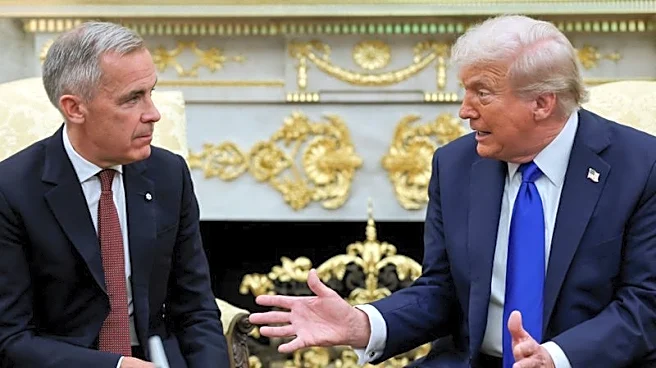
Canada, pending the finalization of documents. President Trump shared the news on Truth Social, stating, "I have paused the 50% Tariffs against Canada, that were scheduled to kick in tomorrow morning for a three day period, based on the fact that Canada and the U.S.A., subject to the finalization of documents, have a DEAL!" His trade representative indicated that the agreement would include market access for American goods and other commitments, though specific details were not provided. President Trump also mentioned the potential revival of the Keystone XL pipeline as a factor in the tariff abatement. Canadian Prime Minister Mark Carney confirmed the pause, acknowledging "substantial progress" but noting that "important work" remains. These tariffs were initially proposed in response to what the U.S. claims are discriminatory trade practices by Canada concerning automobiles, alcohol, and dairy products.
Why It's Important?
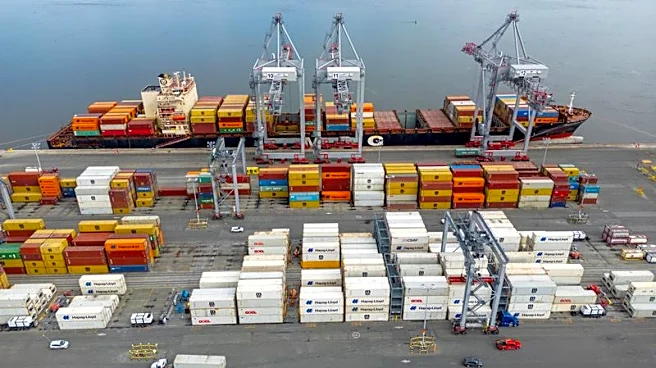
The temporary pause on tariffs signifies a crucial de-escalation in trade tensions between the U.S. and Canada, two of the world's largest trading partners. Had the tariffs gone into effect, they would have impacted approximately 5% of Canadian goods imported by the U.S. last year, potentially raising the average tariff rate on Canadian exports to 6.27% from 4.68%. While the immediate macroeconomic effects might have been limited, the broader implications for the U.S.-Mexico-Canada Trade Agreement (USMCA) were significant. A failure to reach an agreement could have jeopardized the future of USMCA, impacting supply chains, consumer prices, and the competitiveness of various U.S. industries, particularly those reliant on Canadian imports or exports. The mention of the Keystone XL pipeline suggests that energy policy and infrastructure projects are intertwined with trade negotiations, highlighting the multifaceted nature of U.S.-Canada relations. This development offers a window for both nations to resolve outstanding trade disputes and reinforce their economic partnership, benefiting U.S. businesses and consumers by maintaining stable trade relations.
What's Next?
Over the next three days, U.S. and Canadian officials will work to finalize the details of the agreement. The focus will be on securing market access for American goods and addressing Canadian trade practices, particularly in sectors like dairy and alcohol. The outcome of these intensified negotiations will determine whether the tariffs are permanently averted or if trade tensions will resurface. Stakeholders, including U.S. industries, agricultural producers, and consumers, will closely monitor the progress, as a successful resolution could lead to more predictable trade environments. Conversely, a breakdown in talks could result in the re-imposition of tariffs and potential retaliatory measures from Canada, creating economic uncertainty. The future of the Keystone XL pipeline, as hinted by President Trump, could also be a significant component of the finalized deal, impacting energy infrastructure and environmental policy discussions. The coming days will be critical in shaping the future of U.S.-Canada trade relations.
Beyond the Headlines
The last-minute deal to pause tariffs between the U.S. and Canada underscores the complex and often high-stakes nature of international trade negotiations. It highlights how political rhetoric and economic leverage are used to achieve strategic objectives, often coming down to eleventh-hour agreements. The reference to the Keystone XL pipeline suggests that trade disputes are rarely isolated to specific goods but often involve broader geopolitical and economic considerations, including energy security and environmental policies. The tension between the U.S. and Canada, despite their close historical and economic ties, reveals the fragility of even long-standing alliances when national economic interests are perceived to be at stake. This situation also reflects the ongoing debate about protectionism versus free trade, and the impact of tariffs on global supply chains and consumer costs. The resolution of this particular dispute could set a precedent for how the U.S. approaches trade relations with other allies, influencing future trade policies and international economic cooperation.