


What's Happening?
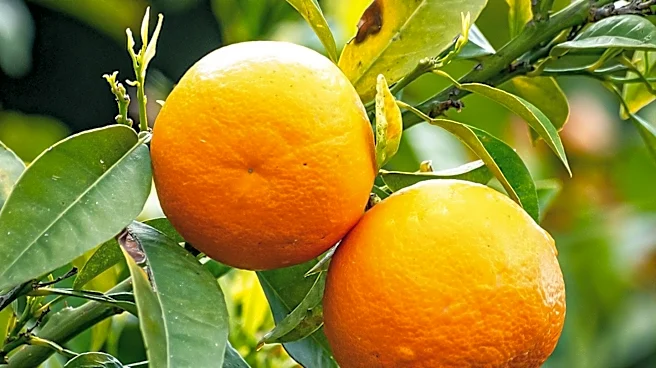
Researchers at the University of Florida (UF) have developed a new rootstock, named CarriCea T1, designed to resist citrus greening disease. This disease has severely impacted Florida's citrus industry, causing a nearly 95% drop in production since its
initial detection, according to the U.S. Department of Agriculture. The U.S. Environmental Protection Agency has approved Soilicea, a company, to sell over 300,000 of these new trees. Mingder Yang, assistant director of UF Innovate, the university's technology commercialization office, stated that this development offers a more permanent solution compared to current methods, such as injecting trees with antibiotics, which are costly and time-consuming. The next phase involves monitoring the long-term effectiveness of these trees in fighting the disease and bearing fruit.
Why It's Important?
The introduction of the CarriCea T1 rootstock is a critical development for Florida's struggling citrus industry. Citrus greening has devastated groves, leading to significant economic losses for farmers and impacting the state's agricultural output. This new, resistant tree offers a potential long-term solution that could reduce reliance on expensive and temporary antibiotic treatments, thereby lowering operational costs for farmers and improving the sustainability of citrus production. A successful rollout and widespread adoption of CarriCea T1 could help revitalize Florida's citrus industry, safeguard jobs, and ensure the continued availability of citrus products. It also highlights the importance of agricultural research and innovation in addressing persistent threats to food security and economic stability in key agricultural regions.
What's Next?
The immediate next step for the CarriCea T1 rootstock is its commercial rollout by Soilicea, with over 300,000 trees approved for sale. Farmers will begin planting these new trees, and their performance in real-world conditions will be closely monitored. Researchers will assess how effectively the trees resist citrus greening over time and their fruit-bearing capabilities. The success of this initial phase will determine the broader adoption and impact of CarriCea T1 on the Florida citrus industry. Continued research and development may also focus on further enhancing resistance or developing complementary strategies to combat the disease, ensuring the long-term viability of citrus farming in the state.
Beyond the Headlines
The development of CarriCea T1 underscores the broader challenge of agricultural resilience in the face of climate change and emerging plant diseases. Citrus greening is just one example of how environmental factors and pathogens can threaten entire agricultural sectors, necessitating continuous innovation in crop science. This situation also highlights the intricate relationship between academic research, government regulation, and commercial application in bringing solutions to market. The success of such initiatives can have far-reaching implications, not only for the specific industry but also for national food supply chains and the economic well-being of agricultural communities. It also raises questions about the balance between natural ecosystems and human intervention in ensuring food production.