



What's Happening?
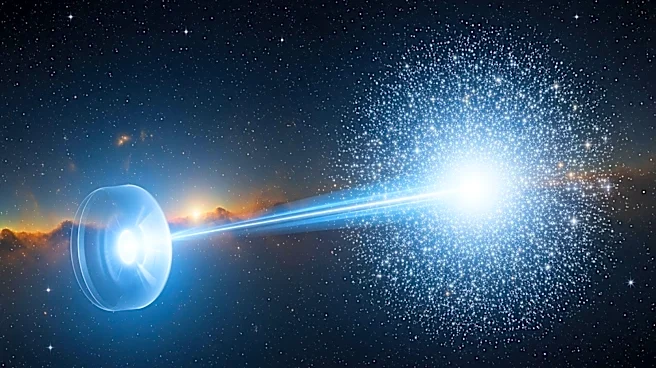
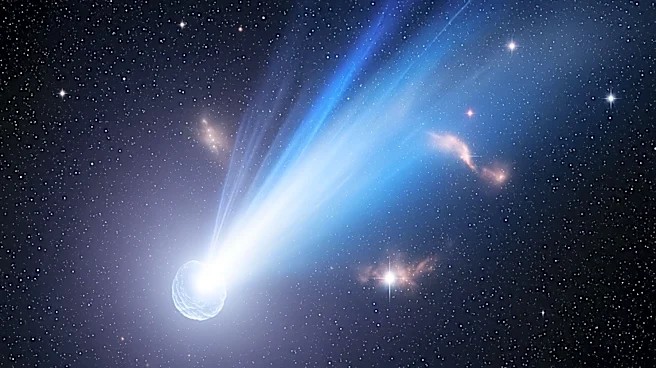
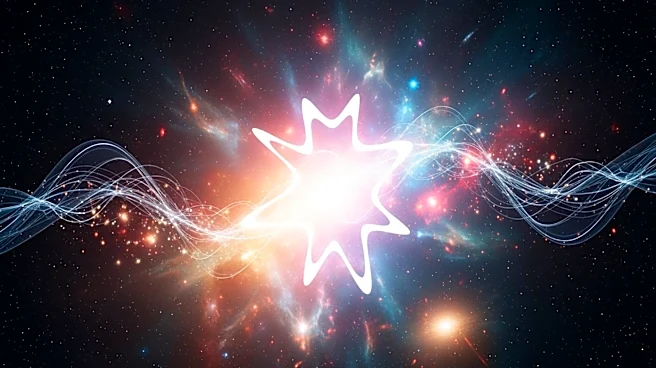
Astronomers have identified a potential second kilonova event, named AT2025ulz, which may represent a new type of cosmic explosion. This event appears to be linked to a supernova that occurred just hours earlier, complicating its interpretation. Led by
Caltech's Mansi Kasliwal, the study suggests this could be a 'superkilonova,' a kilonova triggered by a supernova. The event was first detected by gravitational waves recorded by LIGO and Virgo, followed by observations from the Zwicky Transient Facility. The findings, published in The Astrophysical Journal Letters, indicate that at least one of the colliding objects was unusually small, raising the possibility of two small neutron stars merging.
Why It's Important?
The discovery of a potential superkilonova could expand our understanding of cosmic events and the formation of heavy elements. Kilonovae are rare and significant because they produce elements like gold and uranium, essential for forming stars and planets. This event challenges existing models and suggests new possibilities for how such explosions occur. Understanding these phenomena could provide insights into the life cycles of stars and the evolution of galaxies. The study highlights the importance of multi-messenger astronomy, combining gravitational wave data with electromagnetic observations to explore the universe.
What's Next?
Further analysis and observations are needed to confirm whether AT2025ulz is indeed a superkilonova. Astronomers will continue to search for similar events to better understand their nature and frequency. Upcoming projects like NASA's Nancy Roman Space Telescope and Caltech's Deep Synoptic Array-2000 will play a crucial role in identifying and studying these rare cosmic phenomena. The research community will also focus on refining models to account for the unique characteristics of this event and explore its implications for astrophysics.