


What's Happening?
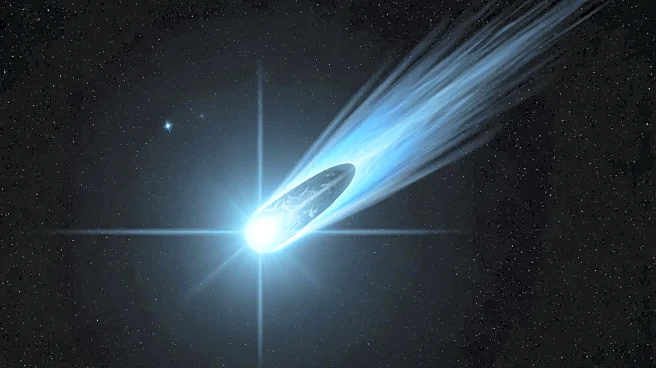
The interstellar comet 3I/ATLAS, first observed in July, is making its closest approach to Earth, coming within 167 million miles. Although not visible to the naked eye, the comet can be observed with a telescope of at least 8 inches in diameter. The Virtual
Telescope Project plans to livestream the event. Recent observations have captured the comet in X-ray images, revealing new details about its composition. The Japan Aerospace Exploration Agency's XRISM mission observed the comet for 17 hours, detecting X-rays extending 248,000 miles from its nucleus. This phenomenon is attributed to interactions between the comet's gases and solar wind. The European Space Agency's XMM-Newton observatory also captured dramatic X-ray images, showing a red glow around the comet.
Why It's Important?
The observation of 3I/ATLAS in X-rays is significant as it provides insights into the behavior and composition of interstellar comets, which differ from those originating within our solar system. Understanding these differences can enhance knowledge about the formation and evolution of celestial bodies beyond our solar system. The findings could also contribute to the broader field of astronomy by offering clues about the materials and processes present in other parts of the universe. This research has implications for future space missions and the study of cosmic phenomena, potentially influencing scientific approaches to exploring interstellar objects.
What's Next?
The comet will remain visible to telescopes and space missions for several more months before it exits the solar system. Continued observations across various wavelengths will help confirm initial findings and further analyze the comet's composition. These studies may lead to new discoveries about interstellar objects and their interactions with solar systems. The scientific community will likely focus on comparing 3I/ATLAS with other interstellar comets to identify patterns or anomalies, which could refine existing models of cometary behavior and composition.