
What's Happening?
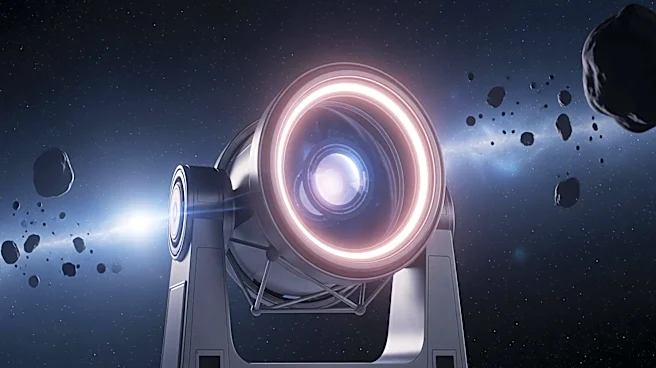
NASA's Near-Earth Object (NEO) Surveyor, an infrared space telescope designed to discover potentially hazardous asteroids and comets, is currently undergoing integration and testing. The mission, set to launch
no earlier than September 2027, aims to identify objects that are difficult to detect with ground-based surveys due to their dark appearance or proximity to the Sun. The NEO Surveyor will scan the solar system to detect these objects by observing the infrared glow they emit when heated by the Sun. This approach contrasts with ground-based surveys that rely on optical light reflection. The mission is a response to a 2005 Congressional mandate for NASA to discover potentially hazardous near-Earth objects.
Why It's Important?
The NEO Surveyor is crucial for planetary defense, as it aims to provide early warnings about asteroids and comets that could pose a threat to Earth. By detecting these objects in the infrared spectrum, the mission can identify those that are otherwise invisible to optical telescopes. This capability is vital for developing strategies to mitigate potential impacts. The mission's success could significantly enhance global preparedness for asteroid threats, potentially saving lives and preventing economic damage. It also represents a significant advancement in space observation technology, contributing to our understanding of the solar system.
What's Next?
As the NEO Surveyor progresses through its integration and testing phases, teams across the United States are focused on building the spacecraft's components and developing the software necessary to process the vast amounts of data it will collect. The mission's launch, planned for no earlier than September 2027, will mark a significant milestone in NASA's efforts to enhance planetary defense capabilities. Once operational, the NEO Surveyor will continuously scan the solar system, providing critical data to scientists and policymakers to inform potential response strategies to asteroid threats.