


What's Happening?
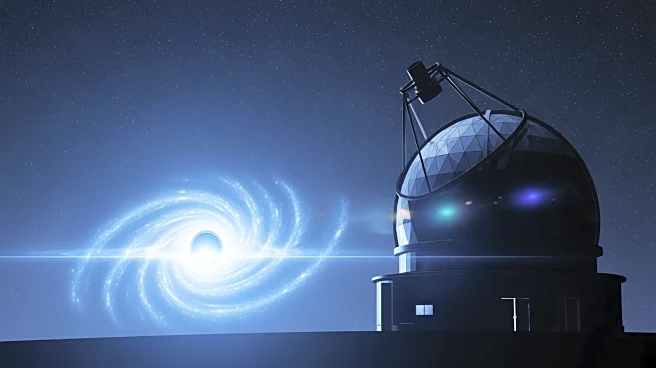
Astronomers from Queen’s University Belfast and the Leiden Observatory in the Netherlands are calling for volunteers to participate in an online challenge aimed at detecting stars being torn apart by black holes. This initiative is part of the Legacy
Survey of Space and Time (LSST), which will capture extensive astronomical data over the next decade from the Vera C Rubin Observatory in Chile. The project is expected to generate an unprecedented amount of data, making manual analysis impractical. Dr. Matt Nicholl from Queen’s University Belfast highlights the potential to detect thousands of black holes consuming stars, with an estimated 10 million alerts each night. The challenge invites tech-savvy individuals, particularly those with experience in AI and machine learning, to analyze simulated data and identify tidal disruption events, where stars are destroyed by supermassive black holes.
Why It's Important?
This project represents a significant advancement in the field of astronomy, leveraging citizen science to tackle the vast data generated by modern observatories. By involving the public, particularly those skilled in AI and machine learning, the initiative democratizes scientific research and accelerates the discovery process. The detection of tidal disruption events is crucial for understanding the properties and behaviors of black holes, which are otherwise difficult to observe. This could lead to breakthroughs in our understanding of the universe, offering insights into the fundamental processes governing celestial bodies. The project also highlights the growing intersection of technology and science, showcasing how AI can be harnessed to solve complex problems.
What's Next?
Participants in the challenge will work through simulated data to develop methods for identifying stars being destroyed by black holes. The project offers a top prize of 1,000 euros for the best score, incentivizing participation. As the LSST begins its operations, the methodologies developed through this challenge could be applied to real data, potentially leading to the discovery of numerous new tidal disruption events. This could prompt further research and collaboration between astronomers and data scientists, fostering innovation in both fields. The success of this initiative may also inspire similar projects in other areas of science, where large datasets are becoming increasingly common.