






What's Happening?
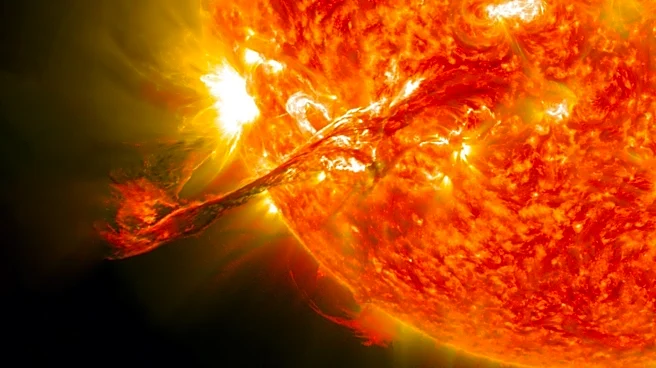
NASA's Solar Dynamics Observatory captured a significant solar flare on June 30, 2026, at 4:50 p.m. ET. This event, classified as an X1.1 flare, represents one of the most intense types of solar flares. Solar flares are powerful bursts of energy that
can affect radio communications, electric power grids, and navigation signals on Earth. They also pose risks to spacecraft and astronauts. The flare was observed as a bright flash in the upper right of the Sun, captured in extreme ultraviolet light, which highlights the extremely hot material in flares. NASA continues to monitor the Sun and space environment with a fleet of spacecraft to study solar activity and its effects on Earth.
Why It's Important?
The occurrence of a strong solar flare has significant implications for various sectors on Earth. Solar flares can disrupt radio communications and navigation systems, which are critical for aviation and maritime operations. They can also affect electric power grids, potentially leading to power outages. For the space industry, these flares pose risks to satellites and astronauts, necessitating protective measures. Understanding and predicting solar activity is crucial for mitigating these risks and ensuring the safety and reliability of technological systems that depend on space weather conditions.
What's Next?
NASA, in collaboration with NOAA's Space Weather Prediction Center, will continue to monitor solar activity and provide forecasts, watches, warnings, and alerts regarding space weather. This ongoing observation is essential for preparing and protecting infrastructure and technology from potential disruptions caused by solar flares. Stakeholders in the aviation, maritime, and energy sectors, as well as satellite operators, will need to stay informed about space weather conditions to implement necessary precautions.
Beyond the Headlines
The study of solar flares and space weather is part of a broader effort to understand the Sun's influence on the solar system. This research contributes to the development of better predictive models for space weather, which can enhance preparedness and response strategies. Additionally, it underscores the importance of international collaboration in space research, as solar activity affects the entire planet and requires a coordinated global response.