







What's Happening?
Trade ministers from the G20 nations are meeting in Milwaukee, Wisconsin, facing a challenging environment largely shaped by President Trump's global tariff agenda. Many attending officials, including those from Canada, are re-evaluating and reshaping
their trading relationships due to new tariffs, barriers, and uncertainty imposed by the Trump administration's 'America-first' policy. The U.S. is also advocating for changes to the World Trade Organization's (WTO) Most-Favoured Nation (MFN) rules, which currently prevent discrimination against member countries by requiring equal tariff rates across the board. U.S. Trade Representative Jamieson Greer argues that the MFN principle was designed for a world where countries broadly adhered to similar rules, and that some nations now benefit from WTO access while engaging in state-led industrial policies or non-market practices. This stance is causing concern among some trade experts, who warn that softening MFN rules could lead to greater global trade unpredictability.
Why It's Important?
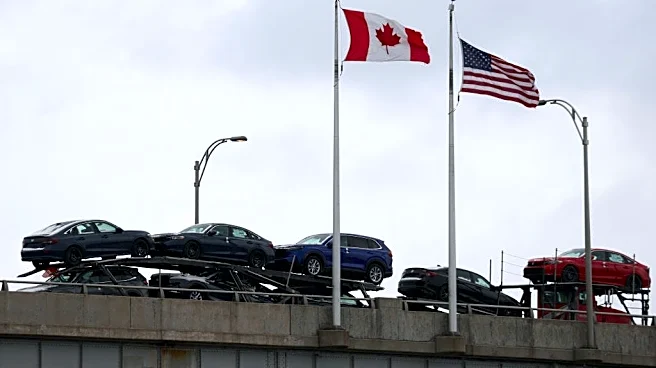
The G20 meeting highlights significant shifts in global trade dynamics, with the U.S. pursuing an 'America-first' agenda that has prompted other nations to seek trade diversification. Canada, for instance, is actively working to reduce its dependency on the U.S. economy, with its non-U.S. trade increasing by 17 percent in the past year. The U.S. push to alter WTO MFN rules could fundamentally reshape international trade. If these rules are softened, it could create a more fragmented and unpredictable global trade environment, impacting international supply chains and potentially leading to economic instability. Businesses relying on consistent trade policies could face increased costs and operational challenges. The ongoing trade disputes and the U.S. import ban on certain Canadian products, including alcoholic beverages, underscore the immediate economic consequences for specific industries and highlight the escalating trade tensions.
What's Next?
The G20 trade ministers' meeting will continue to address issues such as eliminating forced labor in global supply chains and tackling structural and excess capacity, particularly in the steel industry. While U.S. Trade Representative Jamieson Greer is expected to interact with Canadian International Trade Minister Maninder Sidhu, the meeting is not anticipated to be a forum for immediate resuscitation of Canada-U.S. trade talks, which broke down in August. Canada plans to advance negotiations with the European Union and India, aiming for greater access to large and fast-growing economies. The broader discussion on WTO reforms will likely continue, with the organization itself urging members to reform global trade rules to prevent fragmentation and significant economic output reduction, especially impacting poorer countries. The Trump administration's Section 301 investigation into excess industrial capacity will also proceed, with potential new duties being considered.
Beyond the Headlines
The current trade landscape reflects a deeper ideological divergence regarding the principles of global commerce. The U.S. argument for changing WTO MFN rules suggests a move away from multilateralism towards a more bilateral or regional approach, potentially driven by concerns over perceived unfair trade practices by certain countries. This shift could challenge the foundational framework of the WTO, which has historically aimed to ensure a level playing field for all member nations. The emphasis on 'America-first' policies and the resulting trade diversification efforts by other countries could lead to the formation of new trade blocs and alliances, potentially altering geopolitical alignments. The long-term implications include a possible redefinition of international trade norms, with a greater focus on national interests and economic security, potentially at the expense of global economic integration and stability.