






What's Happening?
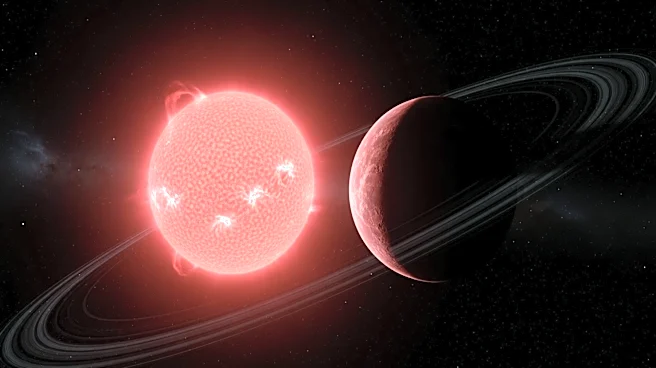
Astronomers from Italy and Brazil have identified a new exoplanet, Ross 318 b, orbiting the red dwarf star Ross 318, located 28 light years from Earth. This discovery was made through a detailed analysis of radial velocity data from the CARMENES spectrograph
and HIRES observations, complemented by data from the Transiting Exoplanet Survey Satellite (TESS). Ross 318 b is a super-Earth with a minimum mass of 6.21 Earth masses and an estimated radius of 1.74 Earth radii. It orbits its host star every 39.63 days at a distance of 0.16 AU, with an equilibrium temperature of approximately 237 K. The planet is likely tidally locked, suggesting it may have a substantial atmosphere capable of redistributing heat, placing it within the conservative habitable zone.
Why It's Important?
The discovery of Ross 318 b is significant as it adds to the growing list of potentially habitable exoplanets. Its location within the habitable zone makes it a prime candidate for future atmospheric studies, particularly with the James Webb Space Telescope. Understanding the atmosphere of Ross 318 b could provide insights into the conditions necessary for life beyond Earth. Additionally, the methods used in this discovery demonstrate the effectiveness of combining multi-instrumental spectroscopy and high-precision photometry to overcome challenges posed by stellar activity, paving the way for future studies of temperate super-Earths.
What's Next?
Future research will likely focus on characterizing the atmosphere of Ross 318 b using advanced telescopes like the James Webb Space Telescope. This could involve transmission spectroscopy to detect atmospheric components and assess the planet's potential for supporting life. The discovery also encourages further exploration of red dwarf systems, which are abundant in the galaxy and may host other habitable planets.