
What's Happening?
Scientists using the James Webb Space Telescope have identified three unusual astronomical objects that may be examples of 'dark stars.' These objects, discovered in early 2025, could significantly alter
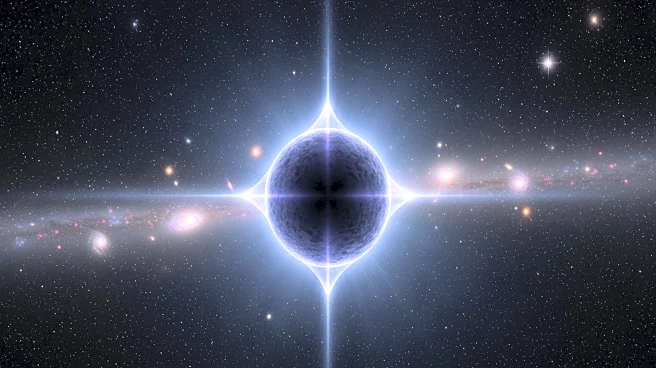
the understanding of star formation. Dark stars are theorized to be powered by dark matter rather than nuclear fusion, which is the traditional energy source for stars. The concept of dark stars suggests that dark matter, a mysterious substance making up about 27% of the universe, plays an active role in star formation by heating primordial hydrogen and helium gases. This process could prevent the typical collapse and ignition of nuclear fusion, resulting in a starlike object that shines due to dark matter annihilation. The discovery of these potential dark stars could provide new insights into the nature of dark matter and its role in the universe.
Why It's Important?
The potential discovery of dark stars is significant as it challenges existing astrophysical models of star formation and the role of dark matter. If confirmed, dark stars could provide a new method for detecting dark matter, which has been elusive due to its lack of electromagnetic interaction. This discovery could also explain the formation of supermassive black holes in the early universe, which traditional models struggle to account for. The existence of dark stars could imply that some stars began as dark stars before transitioning to ordinary stars. This finding could reshape the understanding of cosmic evolution and the formation of galaxies, impacting theories about the universe's structure and history.
What's Next?
Further observational data and theoretical advancements are needed to confirm the existence of dark stars. Researchers will continue to analyze data from the James Webb Space Telescope to distinguish these objects from massive ordinary stars or unusual galaxies. The scientific community may also explore the implications of dark stars on the formation of supermassive black holes and their role in the early universe. As more data becomes available, astrophysicists will refine models of dark matter and its interactions, potentially leading to breakthroughs in understanding the universe's fundamental components.
Beyond the Headlines
The concept of dark stars raises questions about the nature of dark matter and its interactions with ordinary matter. If dark stars are confirmed, they could provide a new perspective on the universe's composition and the processes that govern cosmic evolution. This discovery could also influence the search for dark matter particles and their properties, as well as the development of new technologies for observing the universe. The potential existence of dark stars highlights the complexity of the cosmos and the need for continued exploration and innovation in astrophysics.