
What's Happening?
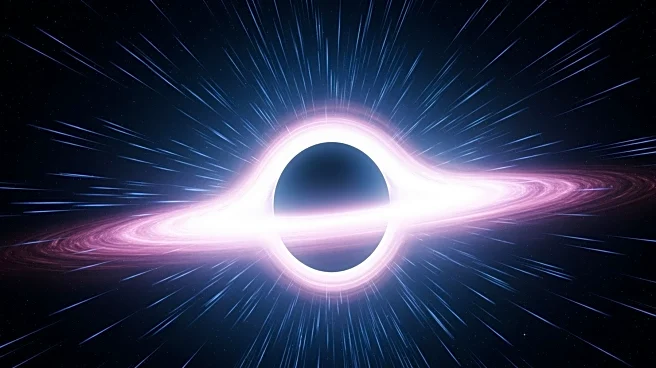
Astronomers have identified the longest gamma-ray burst (GRB) ever recorded, lasting seven hours, which may be linked to a black hole destroying a star. Detected by NASA's Fermi Gamma-ray Space Telescope,
GRB 250702B stands out among approximately 15,000 GRBs due to its unprecedented duration and repeating explosive bursts. The event, originating from a galaxy billions of light-years away, offers a unique opportunity to study such cosmic phenomena. Researchers suggest the GRB could be the result of an intermediate-mass black hole devouring a star, marking a potential new form of cosmic explosion.
Why It's Important?
The discovery of GRB 250702B provides significant insights into the behavior of gamma-ray bursts and the potential role of black holes in such events. Understanding these powerful cosmic explosions can enhance our knowledge of the universe's most extreme phenomena and the conditions that lead to them. The findings may also contribute to the study of black holes, particularly intermediate-mass black holes, which are rarely observed. This research could influence future astronomical studies and the development of theories regarding the formation and evolution of cosmic structures.