
What's Happening?
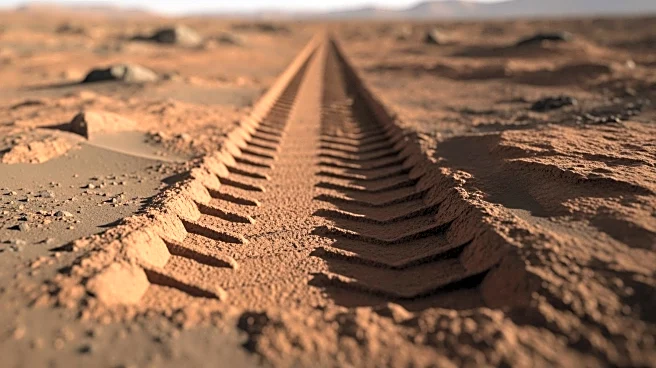
NASA's Perseverance rover has successfully crossed the 42.2-kilometer mark on Mars, equivalent to a marathon distance. This milestone comes as the rover approaches its five-year anniversary, showcasing
its durability and advanced autonomous driving capabilities. Perseverance's ability to navigate the Martian terrain with minimal human input has been a significant achievement, allowing it to collect diverse samples efficiently. The rover is on track to surpass the distance record set by the Opportunity rover, furthering its mission to explore geologically rich areas that may hold clues to past microbial life.
Why It's Important?
Perseverance's achievements underscore the advancements in autonomous technology and its critical role in space exploration. The rover's success in navigating Mars autonomously sets a new standard for future missions, potentially reducing the need for constant human oversight and enabling more efficient exploration. This development is crucial as NASA and other space agencies plan for future missions to the Moon and Mars, where long-range autonomous driving will be essential. Perseverance's findings could also provide valuable insights into the history of Mars and the potential for past life, contributing to our understanding of the planet.
What's Next?
As Perseverance continues its mission, it aims to break the distance record set by the Opportunity rover. The rover's ongoing exploration of the Jezero Crater and its ancient river delta formations will be critical in uncovering evidence of past microbial life. NASA's Jet Propulsion Laboratory will continue to monitor and support the rover's operations, ensuring its systems remain functional for extended exploration. The success of Perseverance's autonomous driving capabilities will likely influence the design and planning of future interplanetary missions, paving the way for more ambitious exploration goals.