







What's Happening?
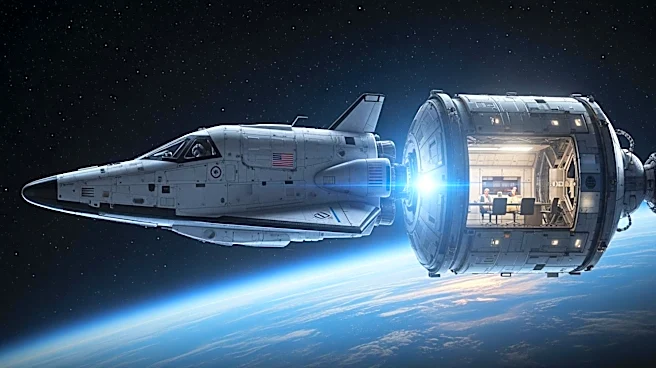
NASA's Artemis II mission has marked a significant milestone by completing the first-ever 'ship to ship' call between a human moon mission and the International Space Station (ISS). The crew aboard the Orion spacecraft, traveling near the Moon, communicated
directly with astronauts on the ISS. This historic call involved Christina Koch on Artemis II speaking with Jessica Meir on the space station, both of whom had previously participated in the first all-female spacewalk in 2019. The mission, which set a new record for the farthest distance humans have traveled from Earth since Apollo 17, reached approximately 252,752 miles from Earth during a flyby of the Moon's far side. This surpassed the Apollo 13 record of 248,655 miles set in 1970. The Artemis II mission is a crucial step in NASA's plan for future lunar exploration, with the crew expected to return to Earth after a 10-day mission, splashing down near San Diego.
Why It's Important?
The Artemis II mission represents a pivotal advancement in human space exploration, demonstrating NASA's capability to conduct complex operations beyond low Earth orbit. The successful communication between the Orion spacecraft and the ISS not only showcases technological advancements but also strengthens international collaboration in space exploration. This mission sets the stage for future Artemis missions, including Artemis III, which will test lunar landing systems, and Artemis IV, aiming to land astronauts near the Moon's south pole by 2028. The achievements of Artemis II could inspire further investment and interest in space exploration, potentially leading to new scientific discoveries and technological innovations. Additionally, the mission underscores the importance of international partnerships in achieving ambitious space exploration goals.
What's Next?
Following the successful completion of Artemis II, NASA is preparing for subsequent missions in the Artemis program. Artemis III, scheduled for next year, will focus on testing lunar landing systems, while Artemis IV aims to achieve a manned landing near the Moon's south pole by 2028. These missions are part of NASA's broader goal to establish a sustainable human presence on the Moon, which could serve as a stepping stone for future missions to Mars. The continued success of the Artemis program will likely influence future space policy and funding decisions, as well as inspire new generations of scientists and engineers.