
What's Happening?
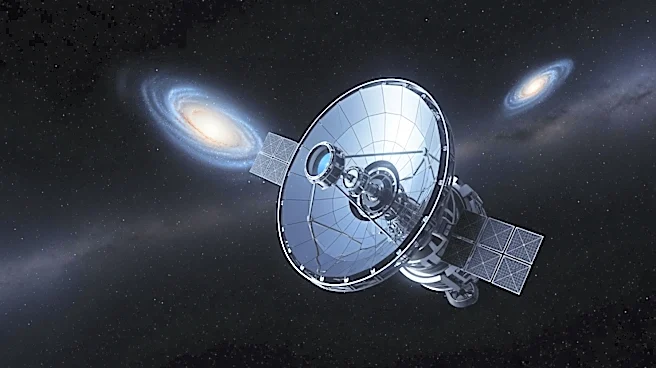
NASA has announced that the Nancy Grace Roman Space Telescope is set to launch in September 2026, eight months earlier than planned. This new telescope is expected to deliver 20,000 terabytes of data over
its lifetime, significantly enhancing the capabilities of astronomers. The Roman Telescope will join the ranks of the Hubble and James Webb Space Telescopes, providing a wide-field view that is 100 times larger than Hubble's. This development marks a significant step in space exploration, as the Roman Telescope will be able to capture vast portions of the sky, aiding in the study of dark energy, exoplanets, and the large-scale structure of the universe.
Why It's Important?
The early launch of the Nancy Grace Roman Space Telescope is crucial for the scientific community as it promises to deliver unprecedented amounts of data, which will be instrumental in advancing our understanding of the universe. The telescope's wide-field capabilities will allow for comprehensive surveys of the sky, potentially leading to new discoveries in astrophysics and cosmology. This could have significant implications for our understanding of dark energy and the expansion of the universe. Additionally, the collaboration with existing telescopes like the James Webb will enable more detailed follow-up studies of rare astronomical phenomena.
What's Next?
Following its launch, the Roman Space Telescope will undergo a series of tests and calibrations before beginning its scientific missions. The data collected will be analyzed by astronomers worldwide, potentially leading to groundbreaking discoveries. The telescope's findings could influence future space missions and the development of new technologies in space observation. As the telescope begins its operations, the scientific community will be closely monitoring its performance and the data it provides, which could lead to further advancements in our understanding of the cosmos.