







What's Happening?
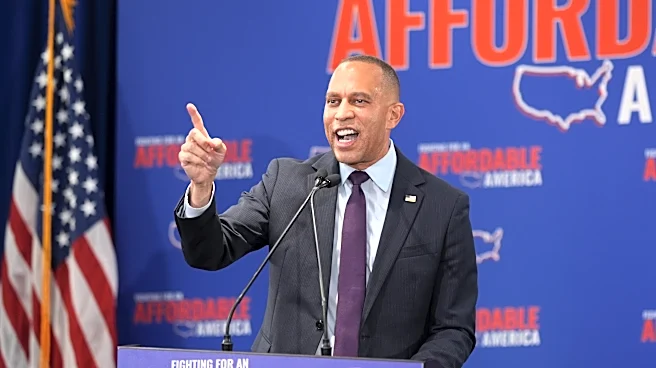
Representative Jay Obernolte (R-Calif.) has co-authored the FRONTIER Act alongside Representative Lori Trahan (D-Mass.), a bipartisan legislative effort introduced in July. This act aims to establish a national framework for advanced artificial intelligence
(AI) models and address catastrophic risks associated with AI development. The FRONTIER Act is part of a broader landscape of AI legislative proposals being considered in Congress, particularly as Democrats prepare a suite of AI bills for a potential majority in January 2027. While several lawmakers are working on various AI frameworks focusing on aspects like minimum safety standards, shutdown authority, and liability rules, the FRONTIER Act stands out due to its bipartisan sponsorship. This makes it a potentially more viable option for moving through committees without being perceived as a partisan attack on the AI industry. The bill's focus on a 'national framework' suggests an effort to create a unified standard for AI regulation across states, potentially preempting a growing patchwork of state-level rules.
Why It's Important?
The FRONTIER Act is significant because it represents a bipartisan approach to AI regulation, which could facilitate its passage in a divided Congress. Its existence as a pre-existing bill with Republican backing provides a template that could be adopted or merged with other proposals, offering a less confrontational path for AI legislation. For the AI industry, a national framework could offer a more predictable regulatory environment compared to navigating diverse state-specific regulations. This could reduce compliance costs and foster innovation by providing clear guidelines. The bill's emphasis on catastrophic risk also signals a growing congressional concern about the potential negative impacts of advanced AI, pushing developers to prioritize safety and ethical considerations. Representative Obernolte's involvement, given his reputation as a technically fluent Republican, could ensure that the legislative discussions are informed by a deeper understanding of AI technologies, potentially leading to more effective and practical regulations.
What's Next?
The FRONTIER Act is positioned as a key bipartisan anchor for future AI legislation, particularly concerning catastrophic risk. As Congress considers various AI proposals, this act could serve as a starting point for negotiations between parties. While no single bill is guaranteed to pass, the FRONTIER Act's bipartisan nature makes it a strong candidate for inclusion in any comprehensive AI legislative package. Stakeholders in the AI industry, including developers, cloud buyers, and investors, should monitor its progress closely, as its provisions could influence future operational standards, testing requirements, and liability frameworks. The debate around a 'national framework' will likely involve discussions on whether it will preempt existing or future state-level AI regulations, a point that will be a significant point of contention among state attorneys general, local officials, and large AI developers.
Beyond the Headlines
The FRONTIER Act's bipartisan nature could signal a shift in how complex technological regulations are approached in the U.S. Congress. By having both Democratic and Republican sponsors, the bill attempts to depoliticize the critical issue of AI governance, potentially setting a precedent for future tech legislation. The concept of a 'national framework' also raises deeper questions about federalism and the balance of power between federal and state governments in regulating emerging technologies. If successful, it could lead to a more harmonized regulatory landscape, but it also risks centralizing control over an industry that thrives on rapid innovation and diverse approaches. The focus on 'catastrophic risk' highlights an evolving understanding of AI's societal impact, moving beyond mere economic benefits to include potential existential threats, which could shape public discourse and ethical considerations around AI development for years to come.