
What's Happening?
Archaeologists at the ancient Roman site of Pompeii have utilized artificial intelligence to digitally reconstruct the face of a man who perished during the AD 79 eruption of Mount Vesuvius. This marks
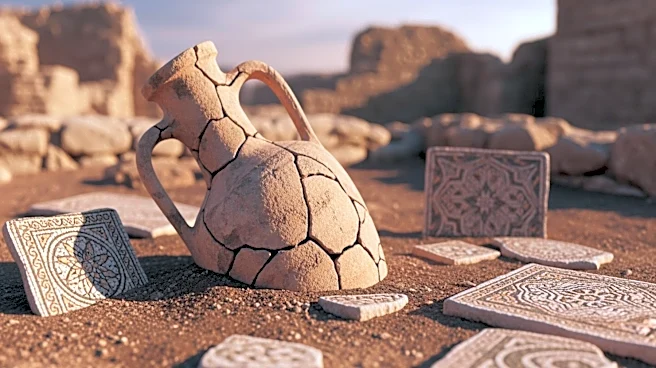
the first time AI has been employed in such a manner at Pompeii, providing a novel perspective on one of history's most infamous natural disasters. The reconstruction was a collaborative effort between the Pompeii Archaeological Park and the University of Padua, based on archaeological survey data from excavations near the Porta Stabia necropolis. The digital portrait depicts the man attempting to flee the city, using a terracotta mortar as a makeshift shield against falling volcanic debris. Alongside the mortar, the man was found with an oil lamp, a small iron ring, and 10 bronze coins, offering a glimpse into his final moments and daily life in Pompeii before the catastrophe.
Why It's Important?
The use of artificial intelligence in archaeology represents a significant advancement in the field, allowing for more detailed and accessible reconstructions of historical events. This project not only enhances public engagement by providing a more tangible connection to the past but also underscores the potential of AI to revolutionize classical studies. By translating skeletal and archaeological data into realistic human likenesses, researchers can offer a more comprehensive understanding of historical events and the people who lived through them. This approach could lead to renewed interest and investment in archaeological research, as well as inspire similar projects at other historical sites.
What's Next?
The success of this AI-driven reconstruction at Pompeii may pave the way for further applications of technology in archaeology. Researchers and institutions might explore similar projects at other sites affected by natural disasters or significant historical events. The Pompeii Archaeological Park plans to continue using AI to enhance the protection and presentation of archaeological data, potentially leading to more interactive and educational experiences for visitors. As AI technology advances, its integration into archaeological research could become more widespread, offering new opportunities for discovery and preservation.
Beyond the Headlines
The ethical implications of using AI in archaeology are worth considering, particularly in terms of accuracy and representation. While AI can provide detailed reconstructions, it is crucial to ensure that these digital portrayals remain faithful to the available data and do not inadvertently distort historical realities. Additionally, the use of AI in this context raises questions about the balance between scientific rigor and public engagement, as well as the potential for commercial exploitation of historical sites. As technology continues to evolve, these considerations will be essential in guiding the responsible use of AI in archaeology.