








What's Happening?
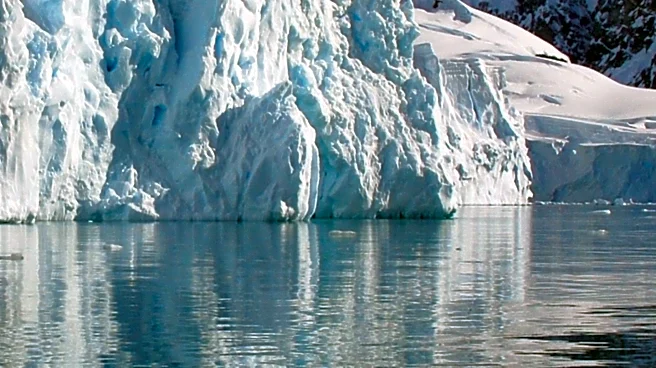
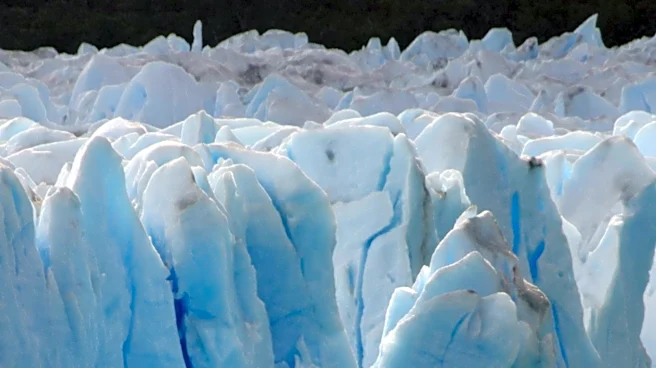
A recent study has mapped the uneven impact of Antarctic ice melt on global sea levels, revealing that the effects are not uniform across the globe. The research, conducted by a team of scientists, utilized computer models to simulate the interactions
between the Antarctic ice sheet, the Earth's solid structure, and global climate systems. The study highlights that as the Antarctic ice melts, it contributes to rising sea levels, but the increase is not consistent worldwide. This is due to gravitational effects, where the mass of the ice sheet attracts ocean water, causing regional variations in sea-level rise. The study predicts that under moderate greenhouse gas emission scenarios, Antarctic ice melt could raise sea levels by about 4 inches by 2100 and over 3.3 feet by 2200. The research also indicates that regions far from Antarctica, such as the Indian, Pacific, and western Atlantic ocean basins, could experience the highest sea-level rise.
Why It's Important?
The findings of this study are crucial for understanding the future impacts of climate change on coastal and island communities. As sea levels rise unevenly, some regions may face more severe consequences, threatening ecosystems and human settlements. This research underscores the importance of reducing greenhouse gas emissions to mitigate these effects. The study also highlights the concept of climate justice, as many island nations, which contribute minimally to global emissions, are already experiencing significant impacts from rising sea levels. These nations are at the forefront of advocating for global efforts to limit temperature increases, emphasizing the need for international cooperation in addressing climate change.
What's Next?
The study suggests that continued research and monitoring of Antarctic ice melt are essential to refine predictions and inform policy decisions. As the global community works towards reducing emissions, understanding the specific impacts on different regions will be vital for developing targeted adaptation strategies. Coastal and island nations may need to implement measures to protect their communities from rising sea levels, such as building sea defenses or relocating vulnerable populations. The study also calls for increased international collaboration to achieve emission reduction targets and support affected regions.
Beyond the Headlines
The research highlights the complex interplay between natural systems and human activities, illustrating how changes in one part of the world can have far-reaching effects. The study's findings may influence future climate policies and adaptation strategies, as governments and organizations seek to address the challenges posed by uneven sea-level rise. Additionally, the study raises ethical considerations about the responsibility of high-emission countries to support those disproportionately affected by climate change, particularly small island nations facing existential threats.