




What's Happening?
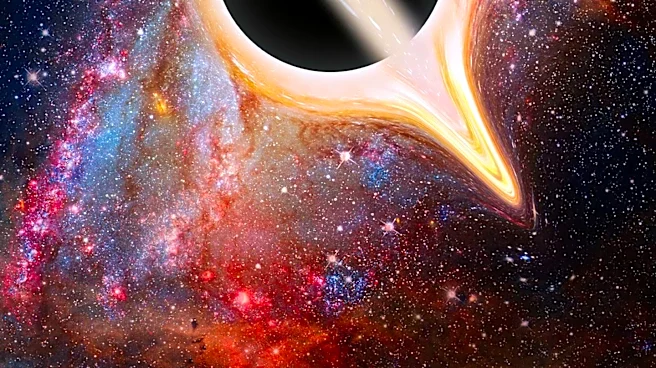
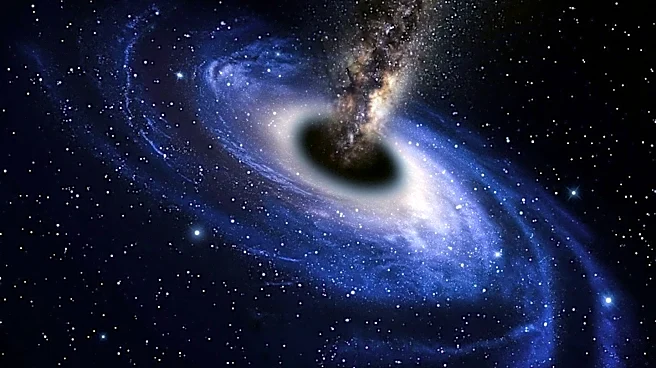
A new theoretical study led by Richard Pinčák and published in General Relativity and Gravitation suggests a potential solution to the longstanding black hole information paradox. This paradox, first identified by Stephen Hawking in the 1970s, arises
from the apparent contradiction between quantum mechanics and the evaporation of black holes, which seems to destroy information. The study proposes that the geometry of a higher dimensional universe, specifically within the framework of Einstein-Cartan theory in seven dimensions, could prevent black holes from completely evaporating. Instead, they would leave behind stable remnants capable of storing information. This theory also connects to the Higgs field, suggesting a geometric explanation for the mass of fundamental particles.
Why It's Important?
The proposed solution to the black hole information paradox could have significant implications for our understanding of quantum mechanics and the fundamental structure of the universe. By suggesting that black holes leave behind remnants that store information, the study challenges the notion that information is lost, aligning with quantum mechanics principles. Additionally, the connection to the Higgs field offers a potential explanation for the mass hierarchy problem in particle physics. If validated, this theory could reshape our understanding of both cosmology and particle physics, providing a unified framework that addresses multiple unresolved issues.
What's Next?
Testing the theory remains a challenge due to the high energy scales involved, which are beyond the reach of current particle accelerators like the Large Hadron Collider. However, the study's predictions could be investigated through astronomical observations, such as detecting the gravitational effects of the proposed black hole remnants or examining the Cosmic Microwave Background for traces of the seven-dimensional geometry. These efforts could provide empirical support for the theory and further our understanding of the universe's fundamental nature.