





What's Happening?
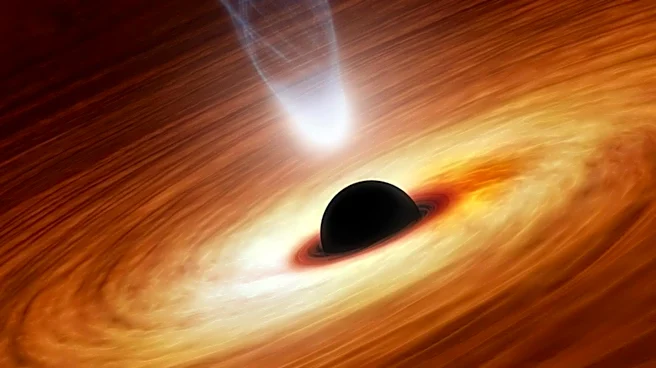
Astronomers have found evidence that narrow plasma jets launched by supermassive black holes leave a directional imprint on the circumgalactic medium (CGM), the vast reservoir of gas surrounding galaxies. Cool ionized gas glows significantly more strongly
along the paths of these jets compared to other regions around the same galaxies. This phenomenon, detailed in a study published in The Astrophysical Journal Letters, combines optical spectra from the Dark Energy Spectroscopic Instrument (DESI) with radio observations from the LOFAR Two-meter Sky Survey. Researchers identified a strong H-alpha emission signal along radio-jet directions, which nearly disappeared when averaged across all directions. This two-part pattern of emission, strengthening near the galaxy and again near and beyond projected radio lobes, provides clues about how mechanical energy travels outward from the black hole, affecting gas hundreds of thousands of light-years away.
Why It's Important?
This discovery is crucial for solving the long-standing mystery of how black holes influence galaxies, their stars, and the conditions for life. While a black hole is tiny compared to its host galaxy, its impact can extend far into the galaxy's outer reaches, affecting the CGM. The CGM is vital as it contains the raw material for future stars. By heating or disturbing this gas, black hole jets can prevent it from cooling efficiently and falling back toward the galaxy, thereby regulating star formation rates in massive galaxies. This feedback mechanism from active galactic nuclei has long been a leading explanation for why many massive galaxies, despite having enormous gas reservoirs, have stopped forming stars. The study provides statistical evidence that jets physically influence cool halo gas in strongly preferred directions, offering a clearer understanding of galaxy evolution.
What's Next?
Future research will likely focus on further quantifying the energy transfer from black hole jets to the CGM and its long-term effects on galaxy evolution. Scientists will continue to use instruments like DESI and LOFAR to observe more radio galaxies and quasars, refining their understanding of the jet-CGM interaction. The findings suggest that earlier studies might have missed this effect by averaging across all directions, so future observational strategies may need to be adjusted to account for the directional nature of jet influence. Understanding how black holes regulate star formation could lead to more accurate models of galaxy growth and the distribution of matter in the universe. Continued exploration of the ethical, legal, or cultural dimensions of such profound cosmic influences is also a possibility, as our understanding of the universe expands.
Beyond the Headlines
The profound influence of supermassive black holes on their host galaxies, extending far beyond their immediate vicinity, highlights the intricate and dynamic nature of cosmic ecosystems. This research underscores that even seemingly small components of a galaxy can have monumental effects on its overall evolution and star-forming capabilities. The ability of black hole jets to regulate the circumgalactic medium suggests a cosmic feedback loop, where the most powerful objects in the universe play a critical role in shaping the destiny of galaxies. This understanding challenges the traditional view of galaxies as isolated entities, emphasizing the interconnectedness of all cosmic phenomena. It also raises deeper questions about the conditions necessary for star formation and, by extension, the emergence of planetary systems and life, positioning black holes as unexpected architects of cosmic habitability.