




What's Happening?
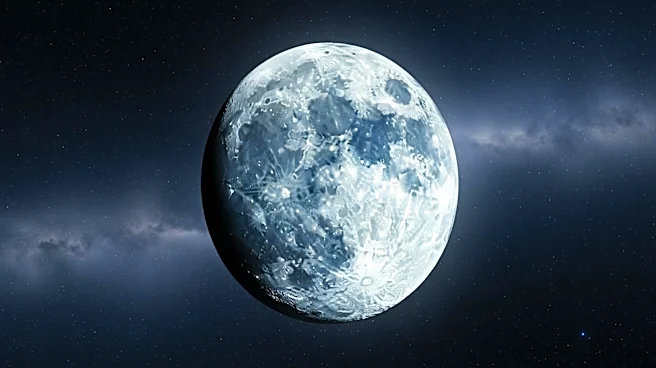
Scientists have discovered that Neptune's moon Nereid may be one of the planet's original moons, surviving a cosmic collision that scattered other moons. Using NASA's Webb Space Telescope, a team led by the California Institute of Technology found that Nereid's
composition is inconsistent with objects from the Kuiper Belt, suggesting it has always been part of Neptune's system. Nereid's eccentric orbit, which takes nearly a year to complete, supports the theory that it was pushed outward by the capture of Neptune's largest moon, Triton. This discovery challenges previous assumptions that Nereid was a captured object from the solar system's outskirts.
Why It's Important?
The findings about Nereid provide new insights into the history and evolution of Neptune's moon system. Understanding the origins of Nereid can help scientists learn more about the dynamics of planetary systems and the processes that shape them. This research also highlights the capabilities of the Webb Space Telescope in studying distant celestial bodies. The study's implications extend to broader astronomical research, offering clues about the formation and migration of moons in our solar system and beyond.
What's Next?
While no missions are currently planned to visit Neptune, further observations using advanced telescopes could provide more detailed information about Nereid and other moons. Continued research may uncover additional evidence about the early solar system and the forces that influenced the current arrangement of planets and moons. The scientific community may advocate for future missions to Neptune to gather more data and confirm these findings.