



What's Happening?
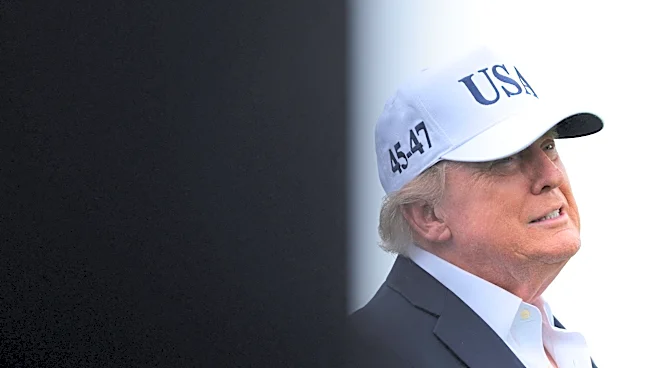
President Trump has publicly dismissed growing calls for increased regulation of artificial intelligence (AI), asserting that the only necessary 'guardrails' for AI are a 'STRONG AND SMART (High IQ!) PRESIDENT.' In a series of Truth Social posts, President Trump characterized
concerns about AI and data centers as a 'hoax' and a 'SICK conspiracy,' suggesting that such efforts are aimed at hindering U.S. leadership in the field and are beneficial only to countries like China. He specifically criticized Anthropic CEO Dario Amodei, who had advocated for a slower development of AI models to mitigate risks, claiming his administration has already prevented AI 'people' from engaging in 'bad, or potentially bad, 'things.'' This stance directly opposes the views of several tech leaders, including Amodei, OpenAI's Sam Altman, and Elon Musk, who have called for greater government oversight to ensure AI safety, address legal liabilities, and promote national security.
Why It's Important?
President Trump's rejection of AI regulation carries significant implications for the future of AI development and governance in the United States. His position suggests a preference for minimal government intervention, potentially allowing for rapid, unfettered innovation but also raising concerns about unchecked risks. This approach contrasts sharply with the growing consensus among many experts and policymakers who believe that robust regulatory frameworks are essential to manage the ethical, societal, and security challenges posed by advanced AI. The debate over AI regulation is critical for determining the balance between fostering technological advancement and safeguarding public welfare, and President Trump's influential voice in this discussion could shape policy directions, potentially impacting U.S. competitiveness, national security, and the global AI landscape.
What's Next?
The ongoing debate surrounding AI regulation is expected to intensify, particularly with President Trump's strong stance. While some in Congress, including House Speaker Mike Johnson, have suggested that President Trump should lead discussions on AI at the White House rather than Congress taking immediate action, pressure for legislative oversight is likely to continue from other stakeholders. Tech leaders and advocacy groups will likely persist in their calls for guardrails, potentially leading to further public discourse and policy proposals. The outcome of this debate will determine whether the U.S. adopts a more hands-off approach to AI development or moves towards comprehensive regulatory measures, influencing investment, research, and the deployment of AI technologies across various sectors.
Beyond the Headlines
President Trump's framing of AI concerns as a 'hoax' and a 'conspiracy' reflects a broader pattern of skepticism towards expert warnings and a preference for a strong, centralized leadership approach to complex issues. This perspective could have deeper implications for how scientific and technological advancements are perceived and managed within the political sphere. It raises questions about the role of scientific consensus in policymaking and the potential for political rhetoric to influence public understanding of emerging technologies. Furthermore, the emphasis on a 'STRONG AND SMART PRESIDENT' as the sole 'guardrail' for AI touches upon fundamental questions of governance, trust in institutions, and the concentration of power in addressing rapidly evolving technological challenges, potentially setting a precedent for future technological governance.