







What's Happening?
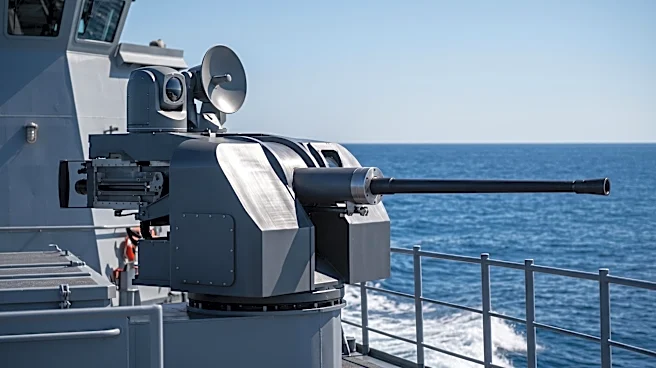
BAE Systems has introduced its Sea Tridon family of 40-mm naval gun systems at the Euronaval 2026 exhibition in Paris. These modular systems are designed for rapid installation, including a variant that can be mounted on top of a standard shipping container,
offering a 'plug-and-play' solution for naval defense. The Sea Tridon systems are based on the Bofors 40 mm L/70 cannon, incorporating nearly a century of technological advancements such as new materials, pre-fragmented programmable ammunition, and digital command and control interfaces. Originally designed for sea duty, these guns were adapted for land use in 2023 to counter drones and loitering munitions, and are now returning to sea. The family includes four configurations: the Bofors 40 Mk 4 Naval Gun, the basic Sea Tridon with integrated fire control, Sea Trinity as a standalone Close-In Weapon System (CIWS) with its own radar, and Sea TridonC, the container-mounted variant.
Why It's Important?
The emergence of modular naval defense systems like Sea Tridon is crucial in response to the rapidly evolving maritime threat landscape, particularly the proliferation of drones and swarming tactics. These systems offer navies and maritime operators unprecedented flexibility and scalability, allowing for quick adaptation to new threats without extensive vessel modifications. The container-mounted Sea TridonC is particularly significant as it enables auxiliary vessels, patrol ships, and even merchant marine ships to be rapidly armed in high-threat environments, addressing legal and logistical challenges associated with arming private vessels. This innovation provides a cost-effective and efficient way to enhance defensive capabilities against both traditional and asymmetric threats, such as piracy and drone attacks, thereby strengthening global maritime security and protecting vital shipping lanes.
What's Next?
BAE Systems will likely focus on marketing and integrating the Sea Tridon family into various naval fleets and maritime security operations worldwide. The modular nature of these systems suggests potential for widespread adoption by navies seeking flexible and rapidly deployable defense solutions. Further development may include enhanced automation, integration with broader combat systems, and adaptation to counter future threats. The concept of containerized weapon systems could also inspire similar modular approaches for other naval defense technologies. As geopolitical tensions and maritime threats continue to evolve, the demand for such adaptable and effective defense solutions is expected to grow, driving further innovation in naval armaments and ship design.
Beyond the Headlines
The Sea Tridon family represents a paradigm shift in naval defense, moving towards highly modular, adaptable, and rapidly deployable weapon systems. This 'plug-and-play' approach challenges traditional naval architecture, which often involves lengthy and costly ship modifications for weapon integration. Ethically, the ability to quickly arm merchant vessels raises questions about rules of engagement for civilian ships and the potential for escalation in maritime conflicts. Legally, it could necessitate new international guidelines for the arming of non-military vessels. Culturally, it reflects a growing recognition of the need for agile defense strategies in an era of unpredictable threats. Long-term, this trend towards modularity could lead to a future where naval platforms are designed with universal interfaces, allowing for rapid reconfiguration of weapon systems, sensors, and other capabilities based on mission requirements, fundamentally altering naval procurement and operational strategies.