
What's Happening?
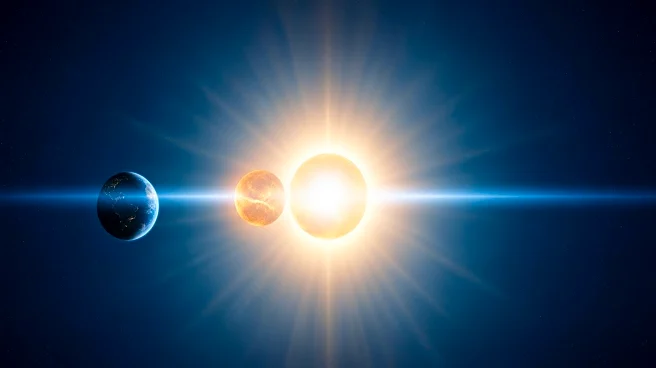
On January 6, 2026, Venus will undergo a superior solar conjunction, aligning behind the sun from Earth's perspective. This astronomical event marks Venus's transition from a morning to an evening object.
During this time, Venus reaches its apogee, the farthest point from Earth in its orbit. The event renders Venus invisible due to the sun's glare, but it is expected to reappear in February and reach its highest altitude in the morning sky by June 5. This alignment is part of the complex orbital dynamics of the solar system, where planets can appear as bright objects or become obscured by the sun's light.
Why It's Important?
The superior solar conjunction of Venus is significant for astronomers and skywatchers as it marks a shift in Venus's visibility and position in the sky. Such events help scientists study planetary orbits and dynamics, contributing to our understanding of the solar system. For the public, it offers an opportunity to observe Venus's phases and movements, enhancing interest in astronomy. The event also underscores the intricate ballet of celestial bodies, providing educational insights into planetary science and the mechanics of our solar system.
What's Next?
Following the conjunction, Venus will gradually become visible again, offering opportunities for observation and study. Astronomers and enthusiasts can prepare to track its reappearance and subsequent movements. The event sets the stage for future observations and educational programs, encouraging public engagement with astronomy. As Venus transitions to an evening object, it will become a prominent feature in the night sky, drawing attention from both amateur and professional astronomers.