








What's Happening?
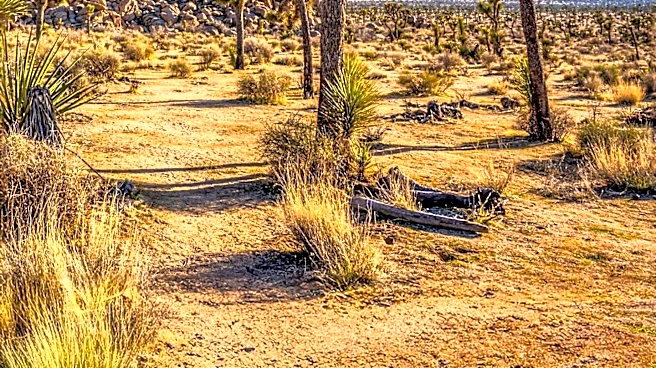
Joshua Tree National Park, located in Southern California across Riverside and San Bernardino counties, serves as a transitional zone between the Mojave and Colorado deserts. Spanning approximately 795,000 acres, the park features diverse landscapes ranging
from flat valleys to mountainous terrains. It is particularly renowned for its distinctive Joshua trees (Yucca brevifolia), which thrive in the higher, cooler elevations of the Mojave Desert section. In contrast, the lower Colorado Desert areas are characterized by thorny bushes, cacti, and open gravel plains, offering visitors a varied desert vegetation experience within a single park. The park also boasts massive rock formations, primarily composed of monzogranite, which have been shaped by extensive weathering into rounded blocks, fissures, and domes, notably in areas like the Wonderland of Rocks. The park was initially designated as a National Monument by President Franklin D. Roosevelt on August 10, 1936, to preserve its unique desert landscape and flora, and later achieved National Park status on October 31, 1994, enhancing its protection and integration into the U.S. National Park system. A significant portion of the park is designated as wilderness, ensuring its pristine, undeveloped state.
Why It's Important?
Joshua Tree National Park holds significant ecological and geological importance as a unique convergence point of two distinct desert ecosystems. Its designation as a National Park and a Biosphere Reserve in the 1980s underscores its international relevance for desert ecosystem conservation. The park's geological features, including the dominant monzogranite formations and older metamorphic rocks like Pinto Gneiss (over a billion years old), provide a living laboratory for studying geological history and processes. The presence of major fault systems, such as the San Andreas Fault south of the park, influences the region's structure, contributing to the formation of oases and spring areas in an otherwise arid environment. For the U.S., the park represents a critical natural heritage site, attracting tourists and researchers alike, and contributing to the understanding and preservation of arid land biodiversity. Its unique blend of flora, fauna, and geological formations makes it a vital area for environmental education and scientific research, highlighting the delicate balance of desert ecosystems and the impact of geological forces over millennia.
What's Next?
Visitors to Joshua Tree National Park can continue to explore its diverse landscapes and engage in various activities. The park's trails, particularly in rocky areas, often involve uneven terrain with boulders and steps, requiring sure-footedness. Given the open desert climate and varying elevations, visitors should be prepared for significant temperature fluctuations and limited natural shade. The park's management will likely continue its efforts in conservation and wilderness preservation, maintaining the integrity of its unique ecosystems. Educational programs and interpretive services will remain crucial for raising awareness about desert ecology and geology. Future initiatives may focus on managing visitor impact to protect sensitive areas, especially given the park's popularity. Ongoing geological studies may further uncover insights into the region's ancient past and active fault lines. The park's role as a Biosphere Reserve suggests continued international collaboration in conservation efforts and research into desert environments.
Beyond the Headlines
Beyond its scenic beauty, Joshua Tree National Park embodies a deeper narrative of resilience and adaptation in extreme environments. The Joshua tree itself, a symbol of the park, represents the unique evolutionary paths life takes to thrive in harsh desert conditions. The park's status as a wilderness area emphasizes the ethical commitment to preserving untouched natural spaces, allowing ecological processes to unfold without human interference. This commitment extends to the cultural significance of the land, which has been home to various indigenous groups for millennia, whose understanding of the desert's resources and rhythms predates modern conservation efforts. The stark beauty and challenging environment of Joshua Tree also offer a profound sense of solitude and connection to nature, fostering a deeper appreciation for the planet's biodiversity and geological wonders. It serves as a reminder of the importance of protecting such unique landscapes for future generations, not just for their ecological value but also for their intrinsic spiritual and aesthetic worth.