



What's Happening?
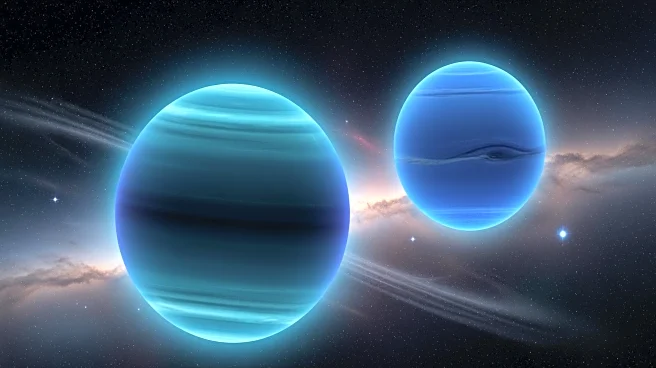
Researchers from the University of Zurich have proposed a new perspective on the composition of Uranus and Neptune, traditionally classified as ice giants. The study, led by Luca Morf and Ravit Helled, suggests that these planets may contain more rock
than previously assumed, challenging the long-standing belief that they are primarily composed of ice. The team developed a novel method for simulating the internal structures of these planets, combining physics-based and empirical models to create unbiased interior models. Their findings indicate that Uranus and Neptune could be either water-rich or rock-rich, depending on which models align with observational data. This research also provides insights into the complex magnetic fields of these planets, suggesting that their magnetic fields are generated by ionic water layers, which could explain their non-dipolar magnetic fields.
Why It's Important?
This research has significant implications for our understanding of planetary formation and composition. By challenging the traditional classification of Uranus and Neptune as ice giants, the study opens up new possibilities for how these planets formed and evolved. This could lead to a reevaluation of planetary models and influence future research into the behavior of materials under extreme planetary conditions. The findings also highlight the need for dedicated missions to Uranus and Neptune to gather more data and refine our understanding of their true nature. Such missions could provide critical insights into the dynamics of planetary interiors and magnetic fields, potentially impacting theories about other planets in our solar system and beyond.
What's Next?
The study underscores the necessity for future space missions to Uranus and Neptune to obtain more precise data on their composition and magnetic fields. These missions could help resolve current uncertainties and refine the models developed by the University of Zurich team. As researchers continue to explore the interiors of these planets, they may uncover new information that could further challenge existing assumptions about planetary formation. The ongoing development of more sophisticated modeling techniques will also play a crucial role in advancing our understanding of these distant worlds.