
What's Happening?
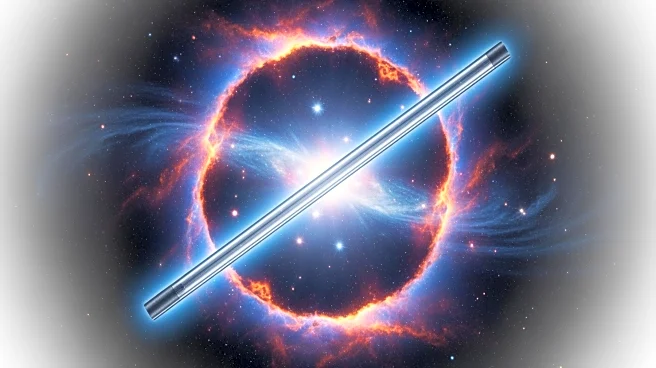
Astronomers have discovered a mysterious 'bar' of iron atoms within the Ring Nebula, also known as Messier 57, located approximately 2,000 light-years away. This discovery was made using the William Herschell
Telescope and its new instrument, WEAVE, which allowed for detailed observation of the nebula's chemical composition. The iron bar, which extends significantly within the nebula, was previously undetected due to the limitations of earlier observational tools. The discovery raises questions about the formation of such structures and whether similar features exist in other planetary nebulas.
Why It's Important?
The discovery of the iron bar in the Ring Nebula is significant as it challenges existing understanding of planetary nebulas and their compositions. This finding could lead to new insights into the processes that occur when stars like our sun exhaust their nuclear fuel and shed their outer layers. Understanding these processes is crucial for astrophysics, as it may provide clues about the future of our own solar system. Additionally, the use of advanced instruments like WEAVE demonstrates the potential for further astronomical discoveries.
What's Next?
Researchers plan to conduct follow-up studies using WEAVE to explore the presence of similar structures in other nebulas. This could help determine whether the iron bar in the Ring Nebula is unique or part of a broader phenomenon. Further analysis may also reveal additional chemical elements co-existing with the iron, which would aid in developing models to explain the formation of such structures.