
What's Happening?
Scientists have achieved a clearer understanding of the universe's expansion and the role of dark energy through the Dark Energy Survey (DES). Utilizing data from the Dark Energy Camera (DECam) on the U.S.
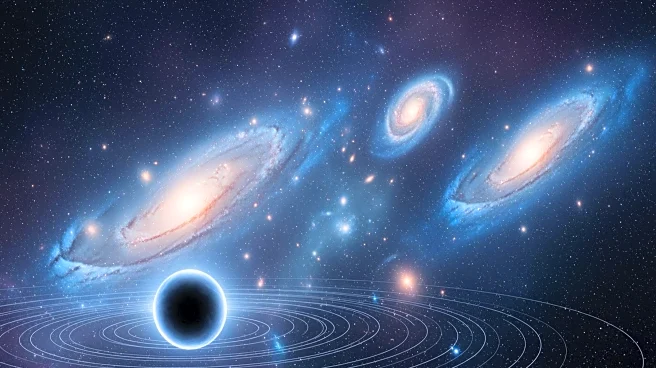
National Science Foundation's Víctor M. Blanco 4-meter telescope, researchers analyzed six years of observations. This data, collected from 2013 to 2019, includes information from 669 million galaxies. The study marks the first time four separate methods of studying dark energy have been combined, doubling the strength of constraints on dark energy's effects. The findings align with the Lambda Cold Dark Matter model, suggesting dark energy's stability over time, but also fit an extended model allowing for its evolution. The results highlight discrepancies in how modern galaxies cluster compared to predictions, emphasizing the need for further research.
Why It's Important?
The findings from the DES are significant as they enhance the understanding of dark energy, which constitutes about 68% of the universe's energy and matter. This research could lead to breakthroughs in cosmology, potentially altering the standard model of the universe. The study's implications extend to various scientific fields, including physics and astronomy, as it challenges existing theories about the universe's structure and expansion. The results could influence future research directions and funding priorities, impacting scientific communities and educational institutions. Understanding dark energy is crucial for comprehending the universe's fate and the fundamental forces shaping it.
What's Next?
The next phase for the DES involves combining DECam data with observations from the Vera C. Rubin Observatory's upcoming Legacy Survey of Space and Time. This collaboration aims to provide an even clearer picture of the universe's history and dark energy's nature. The survey will enable new tests of gravity and further illuminate dark energy's role. These efforts are expected to refine cosmological models and potentially lead to new discoveries about the universe's evolution. The scientific community anticipates that these advancements will open new avenues for research and deepen the understanding of cosmic phenomena.