





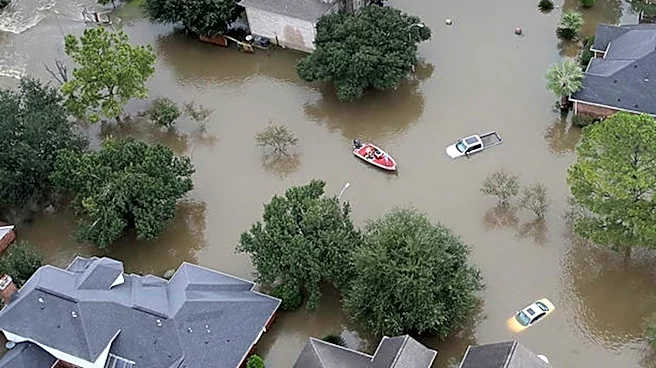


What's Happening?
U.S. Representatives Don Beyer (D-VA) and David Valadao (R-CA) have introduced the bipartisan National Flood Impact Reduction and Resilience Act. This legislation aims to establish a coordinated federal program designed to enhance the understanding of
flood risks, promote more effective mitigation and resilience strategies, and ultimately reduce the loss of life and property due to flooding. The proposed act is structured similarly to the successful National Earthquake Hazard Reduction Program. It would create an interagency committee, led by the Army Corps of Engineers, and include key federal agencies such as FEMA, NOAA, USGS, NIST, OSTP, and OMB, to coordinate planning and implementation efforts. Additionally, the bill calls for an advisory committee comprising representatives from academia, industry standards groups, and state and local governments. This committee would be tasked with assessing advancements in flood resilience science and evaluating the program's overall effectiveness.
Why It's Important?
The introduction of the National Flood Impact Reduction and Resilience Act is significant due to the increasing frequency and severity of flooding events across the United States. By establishing a coordinated federal program, the legislation seeks to streamline efforts that are currently fragmented, leading to more efficient resource allocation and a more comprehensive approach to flood management. This could result in substantial economic benefits by reducing property damage, lowering insurance costs, and minimizing disruptions to local economies. For communities, particularly those in flood-prone areas, the act promises improved safety and stability through better early warning systems, enhanced infrastructure, and more robust recovery mechanisms. The bipartisan nature of the bill underscores a shared recognition of the urgent need to address flood risks, potentially paving the way for broad support and effective implementation. The modeling of this act after the National Earthquake Hazard Reduction Program suggests a proven framework for tackling complex natural disaster challenges.
What's Next?
Following its introduction, the National Flood Impact Reduction and Resilience Act will proceed through the legislative process, requiring committee review, potential amendments, and votes in both the House of Representatives and the Senate. Stakeholders, including environmental groups, state and local government associations, and insurance industry representatives, are likely to engage with lawmakers to advocate for specific provisions or offer support. If passed, the next steps would involve the establishment of the interagency committee and the advisory committee, followed by the development of detailed plans for flood risk assessment, mitigation, and resilience measures. The success of the program will depend on the effective coordination among the various federal agencies and the active participation of state and local entities. Future actions will also include the allocation of federal funding to support the program's initiatives, such as research, infrastructure projects, and technical assistance to communities.
Beyond the Headlines
Beyond its immediate goals of reducing flood impacts, this legislation could foster a broader cultural shift in how the U.S. approaches natural disaster preparedness and climate adaptation. By emphasizing a coordinated, science-based approach, the act could encourage greater investment in preventative measures rather than solely reactive responses. This proactive stance has long-term implications for urban planning, infrastructure development, and environmental conservation, potentially leading to more sustainable and resilient communities. The bill's focus on interagency cooperation could also serve as a model for addressing other complex national challenges that require a unified federal response. Furthermore, by involving academia and industry, the act could stimulate innovation in flood resilience technologies and practices, creating new economic opportunities and enhancing the nation's capacity to adapt to a changing climate. The ethical dimension of protecting vulnerable populations from disproportionate flood impacts is also implicitly addressed by a comprehensive national strategy.