






What's Happening?
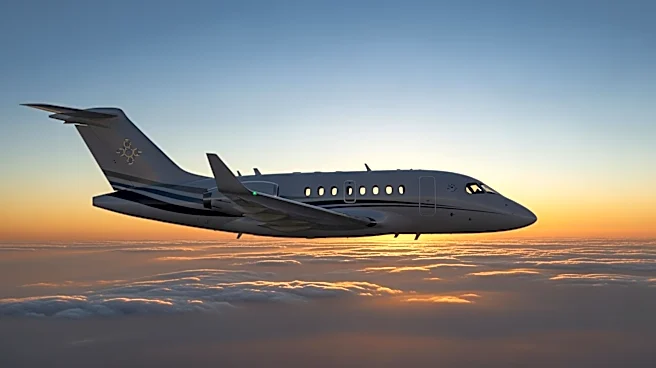
NASA's Boeing 777 aircraft has returned to the Langley Research Center in Virginia after undergoing significant modifications in Texas. These changes transform the aircraft into a next-generation airborne science laboratory, capable of carrying advanced
scientific instruments for Earth observation. The modifications include installing research stations, extensive wiring, and enlarged windows for sensor viewports. The aircraft, acquired in 2022, will replace the retired DC-8 and is set to expand NASA's airborne research capabilities.
Why It's Important?
The Boeing 777's transformation into a flying laboratory represents a significant advancement in NASA's ability to conduct Earth science research. With the capacity to carry 75,000 pounds of equipment and accommodate up to 100 operators, the aircraft will enhance data collection on atmospheric and environmental phenomena. This capability is crucial for improving understanding of climate change, weather patterns, and other Earth systems. The aircraft's first mission, scheduled for January 2027, will focus on high-impact winter weather events, providing valuable data for scientific and public policy applications.
What's Next?
The Boeing 777 will undergo final preparations for its inaugural mission, the North American Upstream Feature-Resolving and Tropopause Uncertainty Reconnaissance Experiment (NURTURE). This mission will collect detailed atmospheric data across North America, Europe, and the Arctic. The data gathered will contribute to better weather forecasting and climate modeling. NASA plans to continue leveraging the aircraft for various scientific missions, potentially collaborating with international partners to maximize research outcomes.