







What's Happening?
Nepal's Prime Minister Balendra Shah has significantly reduced his first bilateral visit to India from three days to approximately 25 hours, scheduled for November 22-23. The visit, initiated by an invitation from Prime Minister Modi, will primarily focus
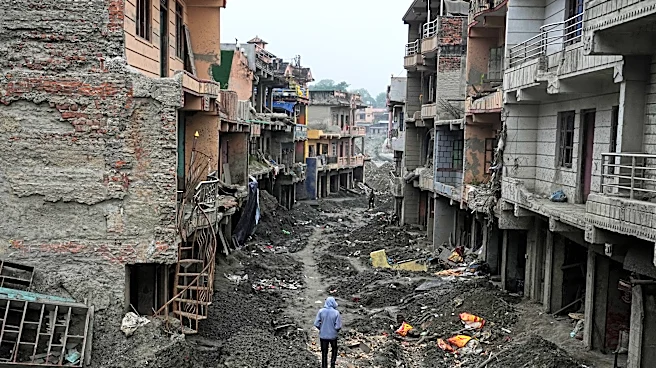
on economic cooperation, connectivity, and addressing pending bilateral projects. During his curtailed trip, PM Shah is expected to hold a 30-minute one-on-one meeting with PM Modi, followed by delegation-level talks. He will also meet President Droupadi Murmu and External Affairs Minister S. Jaishankar. The former Kathmandu mayor, who assumed the premiership in March, has declined invitations to visit other Indian cities like Bengaluru or Ahmedabad, and a planned visit to Uttarakhand has also been canceled, confining his engagements solely to New Delhi. Kathmandu is seeking a substantial $2 billion package from India, comprising $1 billion in loans, $500 million in grants, and an additional $500 million for reconstruction efforts following the August 26 floods. Nepal also aims to secure improved access through Indian airspace for its international airports.
Why It's Important?
The shortened duration of Prime Minister Shah's visit to India, a departure from typical three-to-four-day engagements by previous Nepalese Prime Ministers, signals a focused approach on immediate and tangible outcomes, particularly concerning economic aid and infrastructure. Nepal's request for a $2 billion financial package underscores its urgent need for flood reconstruction and infrastructure development, highlighting the economic vulnerabilities faced by the Himalayan nation. The discussions on hydropower projects and the recruitment of Nepalese Gorkhas into the Indian Army under the Agnipath scheme, despite anticipated differences, are crucial for long-term bilateral relations and regional stability. The outcome of these talks will directly impact Nepal's economic recovery and its strategic relationship with India, a key regional power. For India, the visit presents an opportunity to reinforce its 'Neighborhood First' policy and address long-standing bilateral issues, potentially strengthening its influence in South Asia.
What's Next?
Prime Minister Shah is scheduled to arrive in Delhi on Sunday afternoon and return to Kathmandu on Monday evening. The primary agenda for the visit includes a one-on-one meeting with Prime Minister Modi and delegation-level talks on November 23. While the visit aims to deliver tangible results, particularly on flood reconstruction, hydropower, and stalled projects, officials have not provided a specific reason for the curtailed itinerary. It is anticipated that discussions will cover the proposed $2 billion financial package from India, which includes loans and grants for flood reconstruction and infrastructure projects, as well as improved access to Indian airspace for Nepal's international airports. Differences regarding the Pancheshwar hydro project and the Agnipath scheme for Gorkha recruitment are expected to be addressed, though immediate resolution is unlikely. The focus will be on setting a clear path for future cooperation and addressing Nepal's immediate economic and infrastructural needs.
Beyond the Headlines
The brevity of Prime Minister Shah's visit, while officially unexplained, could reflect a strategic decision by Nepal to prioritize specific, high-impact discussions rather than ceremonial engagements. This shift could indicate a more results-oriented approach in Nepal's foreign policy, particularly with its largest neighbor. The emphasis on securing a $2 billion aid package highlights the significant economic pressures Nepal faces, especially in the wake of natural disasters. The discussions around hydropower projects and airspace access are not merely economic but also carry geopolitical weight, influencing regional energy security and connectivity. The unresolved issues, such as the Pancheshwar hydro project and the Agnipath scheme, underscore the complex and multifaceted nature of India-Nepal relations, where historical ties are often intertwined with contemporary strategic and economic considerations. The visit's outcome could set a precedent for how smaller nations in the region engage with larger powers, focusing on direct negotiations for critical aid and development.