






What's Happening?
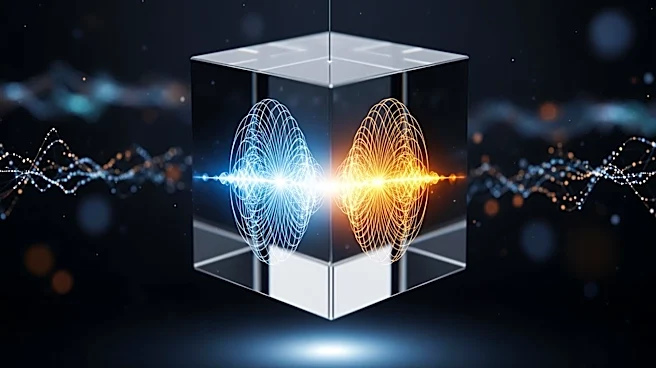
Researchers at the University of Vienna have demonstrated that large metal particles can exist in a quantum state, occupying multiple locations simultaneously. This experiment involved creating cold sodium clusters, which were placed into a superposition
using ultraviolet laser beams. The resulting interference patterns confirmed that these particles, despite their size, obey the principles of quantum mechanics. This study represents one of the most rigorous tests of quantum behavior at a near macroscopic scale, challenging classical notions of how matter behaves.
Why It's Important?
The findings from this study provide new insights into the fundamental nature of quantum mechanics, particularly its applicability to larger, more complex systems. By demonstrating quantum superposition in metal particles, researchers are expanding the boundaries of quantum theory, which traditionally focused on smaller particles like electrons and atoms. This research could have significant implications for the development of quantum technologies, including quantum computing and precision measurement tools. Understanding quantum behavior at larger scales may lead to new applications in nanotechnology and materials science.
What's Next?
Future experiments will aim to explore quantum effects in even larger particles and different materials, providing more stringent tests of quantum theory. Researchers hope to enhance their equipment to achieve greater sensitivity in measuring quantum states, potentially leading to breakthroughs in precision measurements. The continued exploration of quantum superposition in macroscopic systems could pave the way for new technological advancements and deepen our understanding of the quantum world.