



What's Happening?
Kenneth Deardorff, a Vietnam veteran, officially became the last person in U.S. history to receive a homestead title under the Homestead Act when he was granted his federal patent on May 5, 1988. Deardorff moved to Alaska in 1974, initially seeking work,
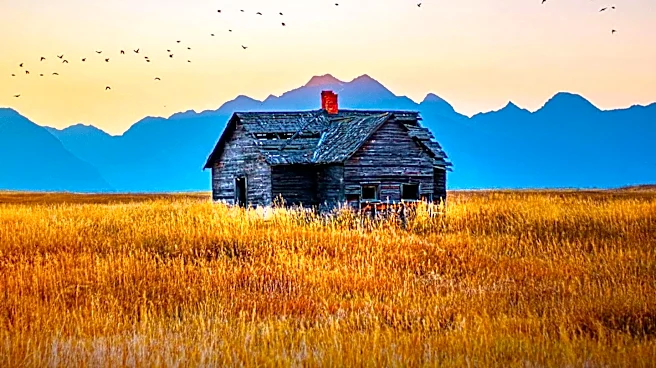
but instead pursued homesteading along the Stony River in southwestern Alaska. He settled in an isolated area, relying on hunting, trapping, and operating a small general store to sustain himself while developing his property. Despite completing the requirements for his homestead in 1979, the official patent was delayed for nine years. The Homestead Act of 1862, which encouraged settlement across the American West, had ended for new claims in the lower 48 states in 1976, with Alaska receiving a special 10-year extension until 1986. Deardorff's claim, filed in 1974, allowed his process to continue, culminating in his historic patent. His story marks the quiet closure of a 126-year-old federal program.
Why It's Important?
Deardorff's story is a significant footnote in American settlement history, representing the final chapter of a federal program that profoundly shaped the nation's expansion and land distribution. The Homestead Act, enacted in 1862, offered public land to citizens willing to cultivate and improve it, playing a crucial role in populating vast territories and fostering agricultural development. Deardorff's experience highlights the enduring appeal of frontier life and self-sufficiency, even as opportunities for acquiring federal land dwindled. His remote Alaskan homestead, built without roads and relying on arduous travel, underscores the challenges and determination required for such a lifestyle. The official recognition of his patent in 2001 by historians and the National Archives solidifies his place as the symbolic end of an era, marking a transition from a period of open land settlement to modern land management and conservation.
What's Next?
While Deardorff's homesteading journey concluded with his patent, his legacy continues through the preservation of his story and artifacts. He later donated items related to his life as a homesteader, including his original patent, to Homestead National Historical Park. In 2017, his 1945 Allis-Chalmers Model C tractor, which he used to clear his land and was transported in pieces by aircraft and dog sled, was recovered from Alaska and preserved. These efforts ensure that future generations can learn about the final chapter of American homesteading. The closure of the Homestead Act signifies a shift in U.S. land policy, moving away from direct land grants for settlement towards other forms of land use, conservation, and management. The historical significance of Deardorff's achievement will likely continue to be studied and commemorated as a unique aspect of American history.
Beyond the Headlines
Deardorff's experience transcends a simple land claim; it embodies the American spirit of self-reliance and pioneering, even in the late 20th century. His decision to build a life in the remote Alaskan wilderness, far from established infrastructure, speaks to a deep-seated desire for independence and connection with nature. The challenges he faced—from transporting a tractor by dog sled to living with monthly mail deliveries—illustrate the extreme conditions that defined frontier life. His story also subtly reflects the evolving relationship between the U.S. government and its public lands, moving from a policy of encouraging settlement to one of greater regulation and environmental consideration. The end of homesteading marks a cultural shift, where the vast, unclaimed wilderness became less about individual acquisition and more about collective stewardship and resource management. Deardorff's life serves as a poignant reminder of a bygone era and the individuals who shaped it.