




What's Happening?
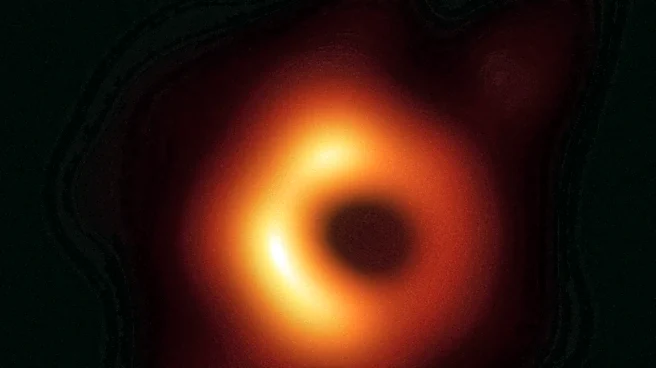
At MIT's Kavli Institute for Astrophysics and Space Research, Professor Erin Kara leads a team dedicated to advancing the understanding of black holes, particularly supermassive black holes (SMBHs). Her group utilizes X-ray reverberation mapping, a technique
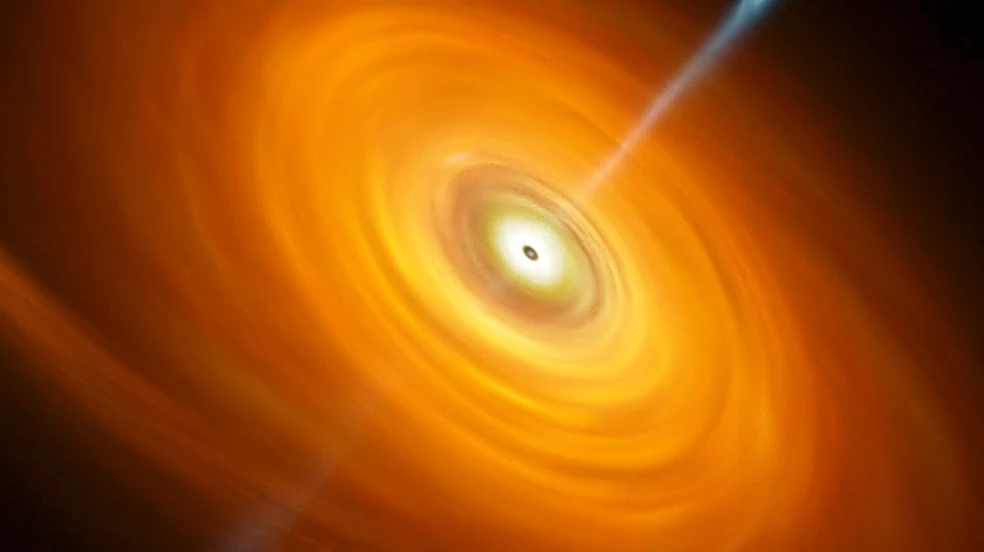
that analyzes X-ray radiation bouncing off the accretion disk surrounding a black hole. This method, pioneered by Andy Fabian and his team in 2009, allows scientists to map the extreme regions around SMBHs. Professor Kara's research, which began with her Ph.D. at Cambridge University, involves analyzing data from various space- and ground-based telescopes, including the X-ray Imaging and Spectroscopy Mission (XRISM) and the Neutron Star Interior Composition Explorer (NICER) on the International Space Station. Her team's work has led to surprising discoveries, such as the rapid variability of black hole systems and faster-than-expected matter accretion, challenging previous assumptions about black hole behavior.
Why It's Important?
This research is crucial for deepening humanity's understanding of the universe's most extreme objects. By mapping the regions around supermassive black holes, scientists can gain insights into how these colossal entities grow, evolve, and influence the formation and evolution of the galaxies they inhabit. The discoveries about the rapid 'on and off' switching of black hole systems and the speed at which matter is consumed challenge existing astrophysical models, potentially leading to a revision of fundamental theories. This advancement in observational techniques, particularly X-ray reverberation mapping, provides a powerful tool for future astronomical studies, enabling more precise measurements and a more comprehensive picture of cosmic phenomena. The work also lays groundwork for future missions like ULTRASAT and LISA, which will further explore black hole mergers and gravitational waves.
What's Next?
Professor Kara's research will expand with upcoming observatories such as the Ultraviolet Transient Astronomy Satellite (ULTRASAT) and the Laser Interferometer Space Antenna (LISA). ULTRASAT will continuously scan the sky for hot, ultraviolet sources, while LISA will detect low-frequency gravitational waves generated by black hole mergers. These future missions are expected to provide unprecedented data, allowing scientists to further refine their understanding of black hole dynamics and their role in the cosmos. The ongoing analysis of data from XRISM and NICER will continue to yield new insights into SMBH coronas and other extreme X-ray sources, including tidal disruption events and black hole outbursts. The goal is to solve new puzzles surrounding supermassive black holes and their interactions with their environments.
Beyond the Headlines
The work at MIT extends beyond mere observation, pushing the boundaries of theoretical astrophysics. The ability to map the immediate vicinity of black holes with increasing precision allows for direct testing of predictions from Einstein's theory of general relativity in extreme gravitational fields. The unexpected rapid variability and accretion rates observed suggest that the universe's most powerful engines operate under more dynamic and complex conditions than previously modeled. This could have implications for understanding energy generation in active galactic nuclei and the feedback mechanisms that regulate star formation in galaxies. Furthermore, the development of advanced X-ray instrumentation and data analysis techniques has broader applications in high-energy astrophysics, contributing to a more holistic understanding of cosmic phenomena and the fundamental laws governing the universe.