
What's Happening?
A team of Egyptian archaeologists has uncovered a significant archaeological find in central Egypt, near Al-Bahnasa, approximately 160 kilometers south of Cairo. The discovery includes mummified remains
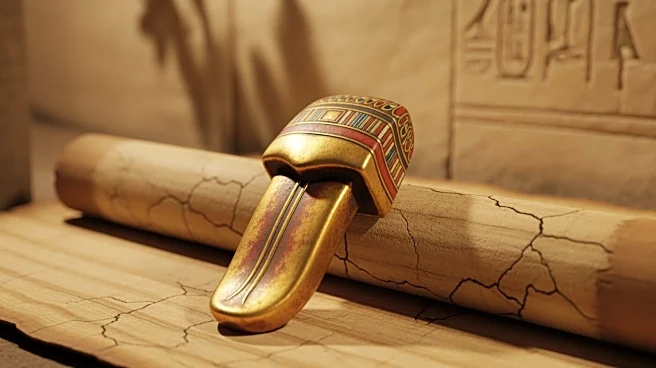
with gold foil tongues and gold-covered fingernails and toenails, dating back over 2,000 years to the Greco-Roman period. These artifacts are part of a rare funerary tradition intended to protect and empower the deceased in the afterlife. The tombs, carved into bedrock, also contained gold crown fragments, gilded decorations, and marble funerary masks, indicating high-status burials. The gold tongue amulets were believed to enable the deceased to speak in the afterlife, particularly before Osiris, the god of the underworld. This find aligns with previous discoveries at Taposiris Magna, where similar gold tongue amulets and coins bearing Cleopatra VII's image were found, suggesting a connection to elite individuals of Egypt's final dynastic era.
Why It's Important?
This discovery sheds light on the complex spiritual and cultural practices during Egypt's Greco-Roman transition. The use of gold in burial rituals highlights the material's divine associations and its role in ensuring immortality and protection in the afterlife. The presence of high-value objects and intricate burial practices suggests a society deeply invested in metaphysical beliefs, even under foreign rule. These findings challenge the narrative of cultural decline during this period, instead illustrating a fusion of Greco-Roman and traditional Egyptian rituals. The discovery also underscores the continuity of religious identity and the adaptation of ancient practices to new political contexts, providing valuable insights into the social and cultural dynamics of ancient Egypt.
What's Next?
Further excavations and research are likely to continue at Al-Bahnasa and Taposiris Magna, as archaeologists seek to uncover more about the burial practices and cultural influences of Egypt's Greco-Roman period. The possibility of discovering Cleopatra VII's tomb in the region adds historical significance to these sites. Ongoing studies may reveal additional artifacts and insights into the lives of Egypt's elite during this era. The findings could also prompt a reevaluation of the period's historical narratives, emphasizing the resilience and adaptation of Egyptian culture under foreign rule.
Beyond the Headlines
The discovery of golden tongues and other burial artifacts opens a window into the lesser-studied aspects of Egyptian history, where identity and religious beliefs were negotiated through burial practices. The use of gold as both a material of wealth and a sacred conduit reflects the enduring spiritual significance of the metal. These artifacts are not merely relics but represent ritual statements intended to last forever, highlighting the deep cultural and religious investments of ancient Egyptian society. The findings contribute to a broader understanding of how ancient civilizations adapted to changing political landscapes while maintaining core cultural and spiritual values.