




What's Happening?
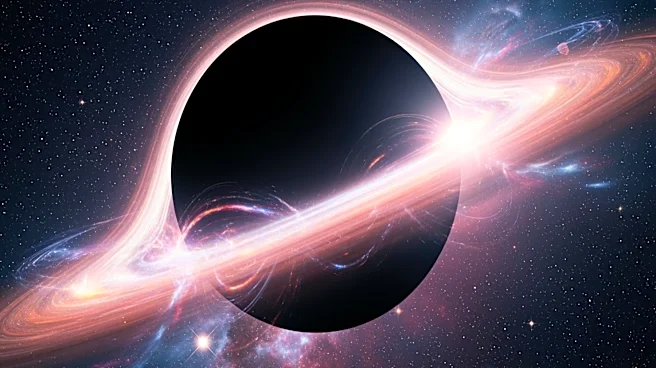
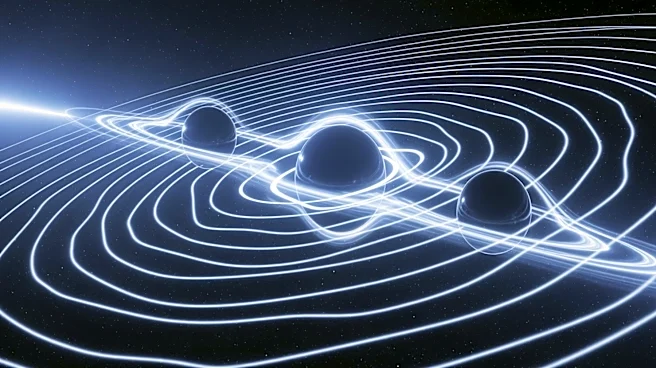
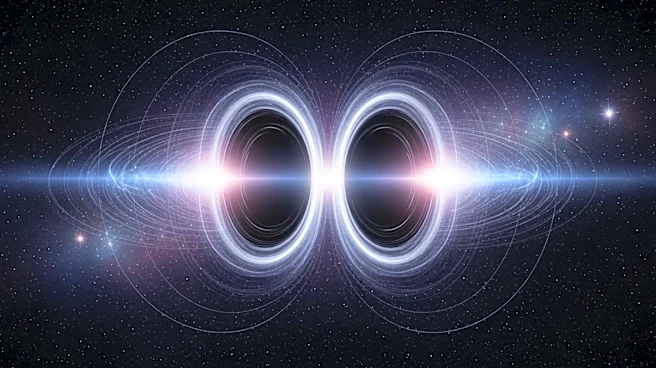
Researchers at the University of Cambridge have conducted numerical simulations that suggest the possibility of forming extremal black holes in finite time under vacuum gravity conditions, potentially violating the 3rd law of black hole mechanics. This
law, akin to the laws of thermodynamics, posits that an extremal black hole, which is charged or spinning to its theoretical limit, cannot form in a finite amount of time. The study, published in Physical Review Letters, indicates that such black holes could emerge from a pre-existing Schwarzschild black hole, challenging the long-held belief that these entities cannot reach zero temperature. The research builds on previous work by Unger and Kehle, who demonstrated that the 3rd law could be false under certain conditions involving charged black holes.
Why It's Important?
This development has significant implications for the field of theoretical physics, particularly in understanding the fundamental laws governing black holes. If extremal black holes can indeed form in finite time, it could reshape existing theories about black hole thermodynamics and entropy. This finding challenges the assumption that black holes cannot reach zero temperature, a cornerstone of black hole mechanics. The research could lead to new insights into the behavior of black holes and the nature of gravity, potentially impacting cosmological models and our understanding of the universe's fundamental forces.
What's Next?
The researchers plan to extend their simulations to four-dimensional vacuum gravity, which presents more technical challenges. If the 3rd law holds in four dimensions, it would reinforce current theories, but if not, it could lead to a paradigm shift in black hole physics. Further studies could explore the implications of zero-temperature black holes and their exotic properties, potentially uncovering new phenomena in general relativity. The scientific community may also investigate the broader implications of these findings on cosmology and quantum mechanics.