






What's Happening?
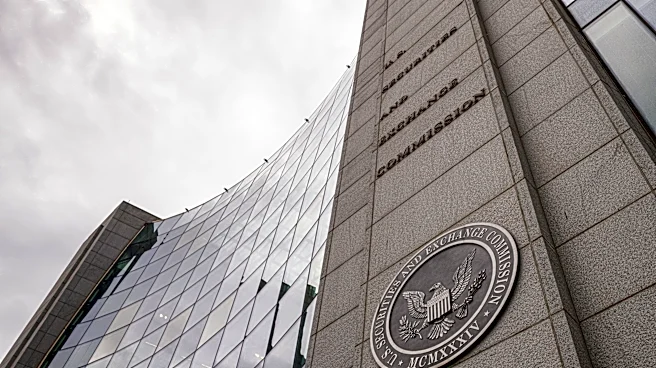
The Securities and Exchange Commission (SEC) has proposed the rescission of Rule 14a-8, a regulation that has long governed shareholder proposals. The SEC's primary rationale for this proposed change is that Rule 14a-8 exceeds its statutory authority
under Section 14 of the Securities Exchange Act of 1934, arguing it improperly intrudes into state law corporate governance matters without explicit congressional authorization. The proposal also cites issues such as the increased cost for companies to respond to shareholder proposals, the low success rate of proposals in achieving majority votes, and the rising volume of submissions. The 2026 proxy season was notably affected by the SEC's decision in November 2025 to cease issuing substantive no-action letters, forcing companies and proponents to navigate shareholder proposal exclusions with a higher risk of litigation.
Why It's Important?
The potential rescission of Rule 14a-8 carries significant implications for U.S. corporate governance and shareholder rights. If rescinded, it would fundamentally alter the mechanism by which shareholders can influence corporate policy and hold management accountable. Companies might gain more autonomy in rejecting shareholder proposals, potentially reducing the administrative burden and costs associated with them. Conversely, shareholders, particularly institutional investors and activist groups, could lose a crucial tool for advocating for environmental, social, and governance (ESG) issues, as well as other corporate reforms. This shift could empower corporate boards and management, potentially leading to less transparency and accountability on certain issues, and could also increase the likelihood of direct litigation as shareholders seek alternative avenues to assert their influence.
What's Next?
The proposed rescission of Rule 14a-8 is likely to face legal challenges, and its ultimate fate remains uncertain. The SEC has indicated that the 2027 proxy season will continue under the 2026 process, meaning companies and proponents will still operate without the certainty of SEC no-action review. States, particularly those competing for corporate charters like Texas and Delaware, may introduce their own legislative frameworks for shareholder proposals to fill the void left by a potential federal rule change. Texas has already enacted an opt-in framework, and Delaware is considering similar measures. Companies may also explore 'private ordering' solutions, such as incorporating shareholder proposal access standards into their bylaws, similar to how proxy access bylaws became widespread. However, these state-level or private solutions are unlikely to fully replicate the comprehensive nature of Rule 14a-8.
Beyond the Headlines
The debate surrounding Rule 14a-8 extends beyond regulatory authority and corporate efficiency, touching upon the fundamental balance of power between shareholders and corporate management. The SEC's argument that the rule infringes on state corporate law highlights a long-standing tension in U.S. corporate governance. The potential removal of a federal mechanism for shareholder proposals could lead to a more fragmented and complex landscape, where shareholder rights vary significantly based on a company's state of incorporation or its specific bylaws. This could disproportionately affect smaller shareholders or those advocating for less financially immediate, but socially significant, issues. The outcome will shape the future of corporate democracy and the extent to which shareholder voices can effectively influence corporate behavior in the U.S.