
What's Happening?
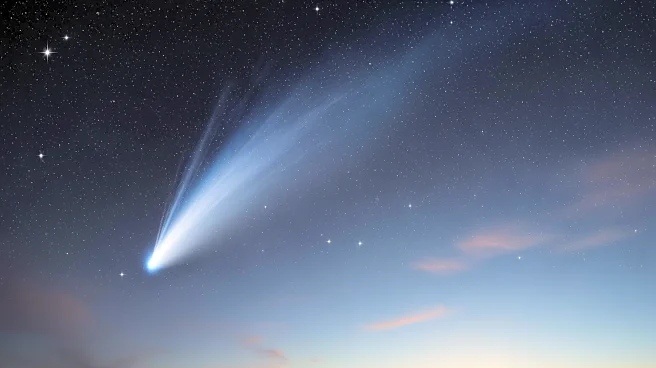
Comet C/2026 A1 (MAPS), discovered in January 2026 by amateur astronomers using a telescope in the Atacama desert, is generating excitement due to its potential visibility in broad daylight this April.
The comet is part of the Kreutz sungrazing family, known for producing some of the brightest comets in history. It is on a highly elongated orbit and will pass very close to the Sun. If it survives this close approach, it could become a spectacular sight in the evening sky. The comet's discovery at a greater distance from the Sun than usual suggests it might be a larger fragment, raising hopes for a bright display.
Why It's Important?
The potential visibility of Comet MAPS in daylight could provide a rare astronomical event, drawing public interest and scientific attention. Such events offer opportunities for research into cometary behavior and composition, contributing to our understanding of these celestial bodies. The comet's appearance could also inspire public interest in astronomy and space science, potentially influencing educational and outreach efforts. Additionally, the event may have cultural significance, as historically, bright comets have been seen as omens or significant celestial events.
What's Next?
Astronomers will continue to monitor Comet MAPS as it approaches the Sun, with observations helping to predict its behavior and potential visibility. If the comet survives its perihelion, it could provide a stunning display in the southern hemisphere's evening sky. The scientific community will likely conduct detailed studies of the comet's composition and trajectory, contributing to broader cometary research. Public interest may lead to increased engagement with astronomy-related activities and events.