



What's Happening?
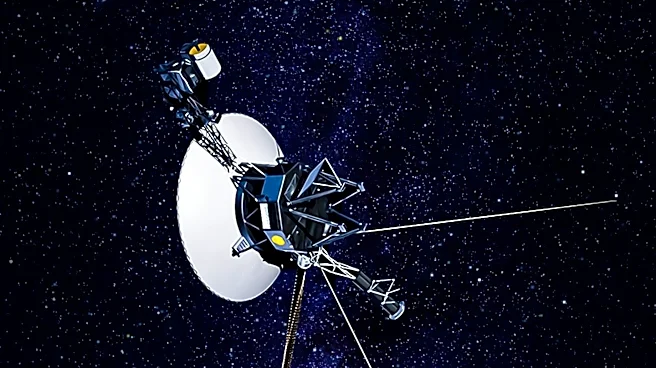
NASA is implementing a power-saving strategy on Voyager 1, which has been operational for nearly 50 years, to extend its mission life. The spacecraft, currently down to two functioning science instruments, is undergoing a procedure similar to one recently
applied to its twin, Voyager 2, which successfully extended its operational life by a year. This involves turning off several aging devices simultaneously and replacing them with lower-power alternatives. The goal is to free up enough power to keep Voyager 1's remaining instruments operational. The spacecraft, which launched in 1977, has been losing instruments over time due to its diminishing power supply. The current effort is crucial as Voyager 1 has less power in reserve compared to Voyager 2 and recently experienced a power dip that nearly triggered an emergency shutdown.
Why It's Important?
The continued operation of Voyager 1 is significant for scientific research, as it provides valuable data from the outer reaches of the solar system. Extending its mission life allows scientists to gather more information about interstellar space, contributing to our understanding of the universe. The power-saving strategy being tested could set a precedent for managing aging spacecraft, offering insights into maintaining long-term space missions. This is particularly important as space agencies look to extend the lifespan of costly and complex missions without the ability to physically service them.
What's Next?
NASA plans to conduct a thermal test on Voyager 1 by the end of August to ensure the spacecraft's temperature remains within safe limits after the power swap. If successful, the procedure will be fully implemented, potentially allowing the reactivation of the Low-energy Charged Particles experiment. This would mark a rare reversal in the mission's trend of shutting down instruments. The outcome of these tests will determine the future operational capabilities of Voyager 1, as it continues its journey through interstellar space.