






What's Happening?
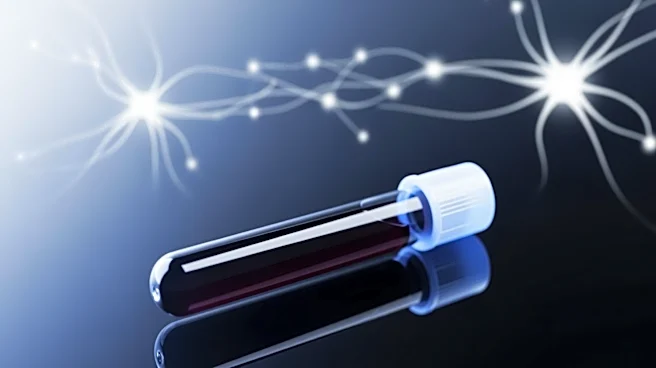
Researchers at Mass General Brigham have identified a blood biomarker, pTau217, that shows promise in predicting the early stages of Alzheimer's disease, potentially decades before symptoms appear. The study involved 317 participants aged 50 to 90, all cognitively
healthy at the start, and followed them for an average of eight years. The blood tests were shown to closely match PET scans in identifying protein tangles and clumps associated with Alzheimer's. The research suggests that pTau217 could serve as an early warning for dangerous accumulations of amyloid-beta and tau proteins in the brain, which are linked to Alzheimer's. However, more data is needed to refine prediction algorithms, and larger, more diverse groups of volunteers are required for further studies.
Why It's Important?
The development of a blood test for early Alzheimer's detection could revolutionize how the disease is diagnosed and managed. Currently, Alzheimer's is diagnosed through a combination of tests and assessments, with no single test available to predict risk years in advance. Early detection through a blood test could allow for earlier intervention and potentially slow the progression of the disease. This advancement could significantly impact public health, given the projected rise in Alzheimer's cases in the U.S. It also highlights the rapid translation of research discoveries into clinical applications, potentially leading to more effective preventive measures and treatments.
What's Next?
The researchers plan to gather more data to improve the accuracy of the prediction algorithms. This will involve recruiting larger and more diverse groups of volunteers. The ultimate goal is to integrate the blood test into clinical practice, providing a simple and non-invasive method for early Alzheimer's detection. As the field evolves, further studies will be needed to confirm the test's efficacy and determine its role in the broader context of Alzheimer's diagnosis and treatment.