







What's Happening?
C.R. Neal Academy in Columbia, South Carolina, has secured a significant regulatory approval from the city's Board of Zoning Appeals. This approval grants a special exception for the establishment of the charter school across two zoning districts, RM-1
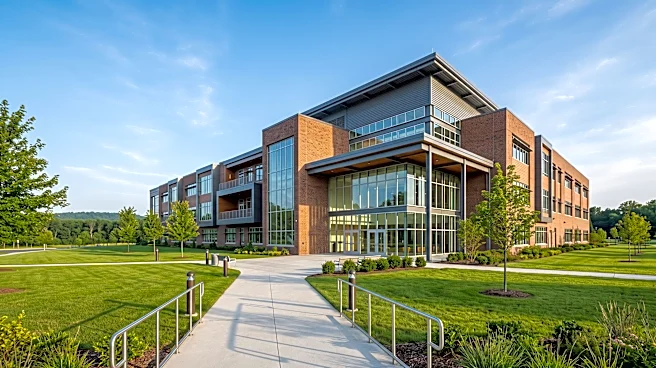
and RSF-3. The project involves combining 26 separate parcels into a single 7.83-acre site on Atlas Road. Developers plan to demolish an existing 3,240-square-foot community center to construct a new 41,000-square-foot facility. The school is set to open in phases, beginning in fall 2027 with an initial enrollment of 260 students across sixth to ninth grades. Within four years, the academy aims to reach its full capacity of approximately 910 students, covering all middle and high school grade levels. C.R. Neal Academy is notable as the first public charter school in the United States authorized by a Historically Black College or University (HBCU), with Voorhees University serving as its authorizer. Student enrollment applications are scheduled to open on Wednesday, October 28, 2026, via the school's website.
Why It's Important?
The establishment of C.R. Neal Academy marks a significant milestone in U.S. education, particularly for the charter school movement and Historically Black Colleges and Universities. As the first HBCU-authorized public charter school, it creates a new model for educational partnerships and expands the influence of HBCUs beyond traditional higher education. This initiative could provide a unique educational environment, potentially offering culturally relevant curricula and strong community ties often associated with HBCUs, to K-12 students. For the Columbia, South Carolina community, the school represents an investment in local education and infrastructure, creating new jobs and educational opportunities. The phased opening strategy allows for controlled growth and adaptation, aiming to serve a substantial number of students in the coming years. This development could also inspire similar partnerships between HBCUs and charter schools nationwide, fostering innovation in public education and addressing educational disparities.
What's Next?
Following the zoning approval, the next immediate step for C.R. Neal Academy is to proceed with the demolition of the existing community center and commence construction of the new 41,000-square-foot facility. Student enrollment applications are slated to open on October 28, 2026, which will be a critical phase for the school to attract its inaugural class. The academy plans to open its doors in fall 2027, initially serving 260 students in grades six through nine. Over the subsequent four years, the school will gradually expand its enrollment and grade levels, working towards its full capacity of 910 students. The success of this pioneering model will likely be closely watched by other educational institutions and policymakers, potentially influencing future collaborations between HBCUs and charter schools across the country. The school will also need to focus on curriculum development, staff recruitment, and community engagement to ensure a successful launch and sustained operation.
Beyond the Headlines
The creation of C.R. Neal Academy carries profound implications beyond its immediate educational impact. This initiative could redefine the role of HBCUs in the broader educational landscape, positioning them as key players in K-12 education reform and community development. By authorizing a charter school, Voorhees University is extending its mission to foster academic excellence and cultural heritage to a younger demographic, potentially creating a pipeline of students prepared for higher education. This model could also serve as a powerful tool for addressing educational inequities in underserved communities, offering an alternative to traditional public schools. The school's success could challenge existing perceptions of charter schools and HBCUs, demonstrating a synergistic approach to educational advancement. Furthermore, it highlights the evolving strategies for educational institutions to remain relevant and impactful in a changing societal context, emphasizing community-centric and culturally affirming educational practices.