






What's Happening?
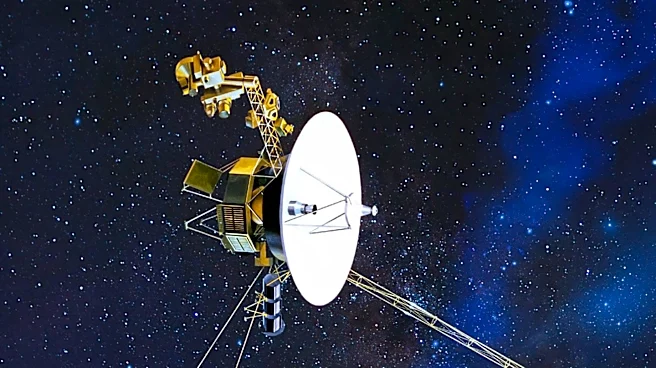
The Japanese spacecraft Hayabusa2, operated by the Japan Aerospace Exploration Agency (JAXA), has successfully completed a flyby of the asteroid Torifune. This mission marks an extension of Hayabusa2's original mission, which initially involved collecting
samples from the asteroid Ryugu and returning them to Earth. The flyby of Torifune, a 450-meter-long asteroid, occurred on Sunday, with the spacecraft passing within approximately 800 meters of the asteroid. Observations began two weeks prior to the flyby and continued until the closest approach. However, data collection was halted after the spacecraft passed the asteroid. JAXA has stated that only part of the data has been transmitted to Earth, with the remainder to be sent during future operations.
Why It's Important?
The successful flyby of Torifune by Hayabusa2 is significant as it demonstrates the spacecraft's extended capabilities beyond its initial mission. This mission extension allows scientists to gather more data on asteroids, which are considered to be remnants from the early solar system. Understanding these celestial bodies can provide insights into the formation and evolution of the solar system. Additionally, the mission showcases the potential for long-term space exploration missions, as Hayabusa2 continues to operate effectively years after its primary mission was completed. The data collected from Torifune could contribute to future asteroid exploration and potential resource utilization.
What's Next?
Following the successful flyby of Torifune, JAXA plans to continue analyzing the data collected during the mission. The remaining data will be transmitted to Earth in future operations, allowing scientists to conduct a comprehensive study of the asteroid. The Hayabusa2 mission is set to continue its journey to another asteroid, 1998 KY26, which it is expected to reach in 2031. This ongoing mission will further enhance our understanding of small celestial bodies and their potential impact on Earth.