




What's Happening?
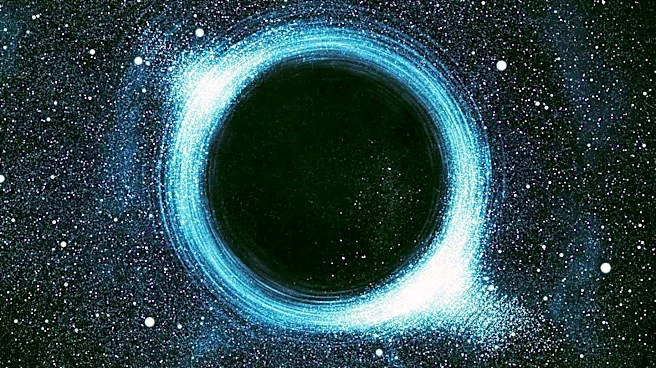
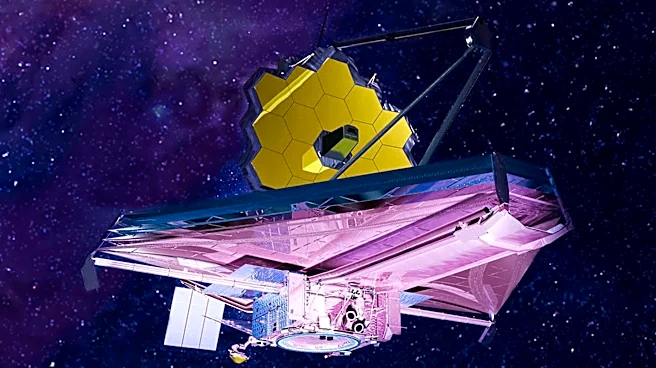
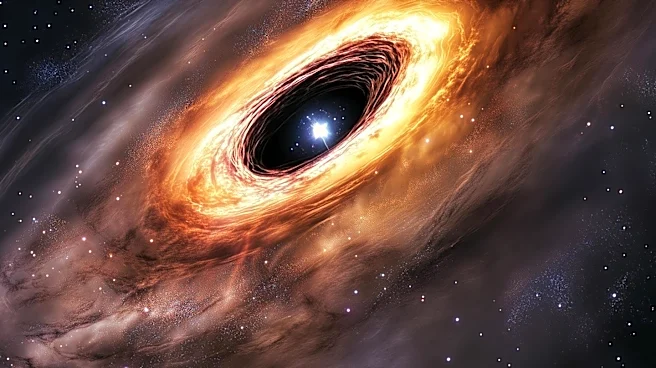
Recent advancements in black hole research are focusing on the next generation of observatories, such as the Black Hole Explorer, which aim to capture subtle features like photon rings. These features reveal the geometry of spacetime around black holes.
The Event Horizon Telescope collaboration is working on creating a movie of the black hole M87, which will show a dark shadow surrounded by a glowing halo from gas swirling around the black hole. This effort is part of a broader initiative to understand the complex interactions of light and matter in the extreme environments near black holes. The research highlights the importance of preserving hidden time delays in photon paths, which are crucial for accurate imaging of these cosmic phenomena.
Why It's Important?
The development of advanced black hole observatories is significant for astrophysics as it enhances our understanding of the universe's most mysterious objects. By capturing detailed images and movies of black holes, scientists can test theories of general relativity and gain insights into the behavior of matter under extreme gravitational forces. This research could lead to breakthroughs in our understanding of spacetime and the fundamental laws of physics. The ability to observe photon rings and other subtle features will provide a more comprehensive picture of black hole dynamics, potentially leading to new discoveries about the universe's structure and evolution.
What's Next?
The Event Horizon Telescope collaboration's ongoing work to create a movie of M87 is a key step in advancing black hole research. As technology improves, future observatories will likely provide even more detailed observations, allowing scientists to explore previously inaccessible aspects of black holes. This could lead to new theoretical models and a deeper understanding of the universe. The success of these projects may also inspire further investment in space-based observatories, expanding our ability to study other cosmic phenomena.