



What's Happening?
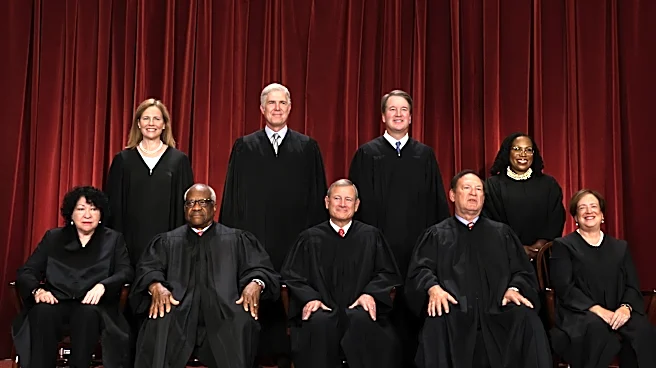
Supreme Court Justice Clarence Thomas has voiced significant concerns regarding the constitutionality of broad prohibitions on carrying firearms in 'sensitive places' such as mass transit and hospitals. This statement was made in connection with the Supreme Court's
decision to decline a Second Amendment challenge to Maryland's firearm restrictions in the case of Novotny v. Moore. While Justice Thomas agreed with the court's refusal to hear this specific case, citing its broad scope as potentially complicating, he emphasized that the court should, in a more narrowly focused future case, scrutinize states' authority to implement such bans. He noted that Maryland is among several states that restrict 'law-abiding gun owners from carrying firearms in a wide variety of public places,' and he harbors 'serious doubts that our Nation’s historical tradition of firearm regulation supports many of these sweeping restrictions.' Justice Thomas concluded that the court should eventually consider 'whether particular sensitive-place laws are consistent with the right to public carry.' This stance reinforces his position as a leading proponent of gun rights on the Supreme Court, following his authorship of the 2022 Bruen ruling, which expanded gun rights by establishing a historical tradition test for firearm regulations.
Why It's Important?
Justice Thomas's statement is significant as it signals a potential future direction for Second Amendment jurisprudence, indicating that the Supreme Court may eventually revisit the legality of 'sensitive place' gun bans. His 'serious doubts' challenge the current regulatory frameworks in states like Maryland, New Jersey, New York, California, Hawaii, and Illinois, which have enacted extensive gun-free zones. These state laws, often implemented in response to the Bruen decision, are now under implicit scrutiny from a key Supreme Court Justice. If the Court were to take up a more focused case and rule in line with Justice Thomas's expressed doubts, it could significantly curtail states' abilities to designate areas as gun-free, potentially leading to more firearms in public spaces previously deemed off-limits. This would represent a substantial shift in gun control policy, impacting public safety debates, law enforcement practices, and the rights of gun owners across the nation. The ongoing tension between Second Amendment rights and public safety concerns would be further intensified, with potential legal challenges arising in numerous jurisdictions.
What's Next?
While the Supreme Court declined to hear the Maryland case, Justice Thomas's statement explicitly calls for the court to address the constitutional limits of 'sensitive place' gun restrictions in a future, more narrowly defined case. This suggests that gun rights advocates and legal organizations, such as the Second Amendment Foundation, will likely seek out and bring forward cases that specifically challenge gun bans in particular types of locations, rather than broad, multi-faceted challenges. The Supreme Court is already scheduled to hear arguments in December for consolidated cases, Viramontes v. Cook County and Grant v. Higgins, which challenge 'assault weapons' bans in Illinois and Connecticut. Although distinct from 'sensitive place' issues, these cases demonstrate the Court's continued engagement with Second Amendment matters. Future cases focusing on specific 'sensitive places' could lead to landmark rulings that redefine the scope of public carry rights and the extent of state regulatory power over firearms in various public and private settings.
Beyond the Headlines
Justice Thomas's statement delves into the deeper constitutional interpretation of the Second Amendment, particularly concerning the 'historical tradition of firearm regulation' test established in the Bruen ruling. His skepticism about modern 'sensitive place' bans suggests a view that many contemporary restrictions lack sufficient historical precedent, potentially setting a high bar for states to justify such regulations. This perspective could lead to a re-evaluation of what constitutes a historically permissible restriction on firearm carry, potentially narrowing the scope of government authority. The implications extend beyond gun rights, touching upon the balance of power between federal and state governments in regulating fundamental rights. Furthermore, it highlights the ongoing judicial debate about how historical analysis should be applied to contemporary legal questions, especially in areas where societal norms and technological advancements have evolved significantly since the framing of the Constitution. This judicial philosophy could influence other areas of law where historical interpretation is central to constitutional challenges.