



What's Happening?
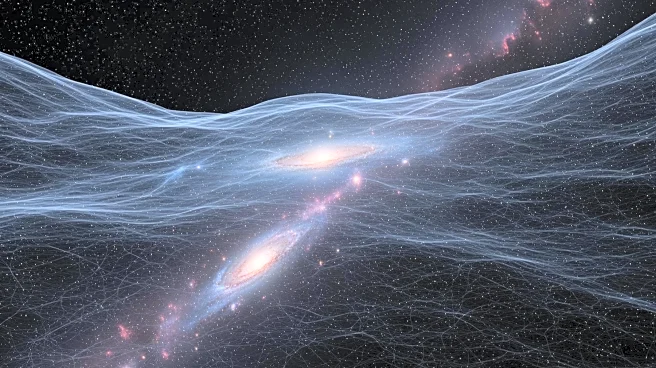
An international team of researchers, led by Ewoud Wempe from the Kapteyn Institute, has discovered a vast cosmic structure surrounding the Local Group, which includes the Milky Way and Andromeda galaxies. This structure, described as a broad, flattened
sheet, extends tens of millions of light-years and comprises both ordinary and dark matter. The discovery was made using advanced computer simulations that replicate the positions and velocities of galaxies near the Local Group. This model, which the researchers call a 'virtual twin' of our cosmic environment, helps explain why most large galaxies near the Milky Way appear to be moving away rather than being drawn inward by gravity. The simulations suggest that the mass within this cosmic sheet counterbalances the gravitational pull of the Local Group, influencing the movement of surrounding galaxies.
Why It's Important?
This discovery is significant as it provides a new understanding of the distribution and influence of dark matter in our cosmic neighborhood. By accurately modeling the mass distribution around the Local Group, scientists can better understand the dynamics of galaxy movements and the role of dark matter in shaping the universe. This research could lead to more accurate predictions about the behavior of galaxies and the evolution of cosmic structures. The findings also offer insights into the early universe's conditions, as the simulations began with data from the cosmic microwave background. This advancement in cosmological modeling enhances our comprehension of the universe's large-scale structure and the forces that govern it.
What's Next?
Future research will likely focus on refining these simulations to include more detailed data and exploring other regions of the universe to see if similar structures exist. Scientists may also investigate the implications of this cosmic sheet on galaxy formation and evolution. Additionally, the study could inspire new observational campaigns to detect and map dark matter distributions more precisely. As the model aligns with current cosmological theories, it may also be used to test new hypotheses about the universe's expansion and the role of dark energy.
Beyond the Headlines
The discovery of this cosmic sheet highlights the intricate balance of forces in the universe and the complex interplay between visible and dark matter. It underscores the importance of computer simulations in modern astronomy, allowing researchers to visualize and understand phenomena that are otherwise invisible. This research also raises questions about the nature of dark matter and its interactions with ordinary matter, potentially guiding future theoretical and experimental studies in particle physics and cosmology.