





What's Happening?
Firefighter and researcher Marc Castellnou, along with the GRAF/Bombers Catalonia team, is actively measuring wildfire plumes to better understand and predict extreme fire behavior. This research is crucial as heat waves and droughts, intensified by climate
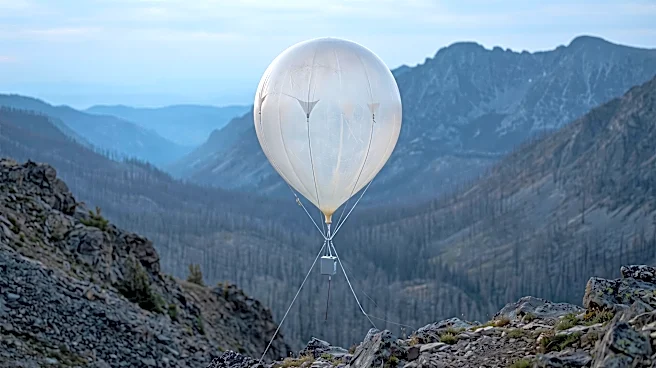
change, are making wildfires more unpredictable and devastating. Unlike many natural hazards, extreme wildfires can rapidly accelerate, creating their own weather systems by generating enormous plumes that rise several kilometers into the atmosphere, sometimes forming pyroclouds. These plumes interact with the surrounding atmosphere, producing powerful winds that can alter fire behavior and sustain extreme spread. Castellnou employs weather balloons to gather real-time data on temperature, wind, and humidity both inside and outside these wildfire plumes. By combining these unique measurements with meteorology and computer models, his research aims to provide firefighters with critical information to anticipate and respond to rapidly changing fire conditions, even before pyroclouds fully form. This approach also helps explain why some extreme wildfires continue to burn fiercely through the night, as fire-modified atmospheres can persist after sunset.
Why It's Important?
This research is profoundly important for enhancing wildfire management and protecting communities across the U.S. and globally. Extreme wildfires pose significant threats to human lives, property, and ecosystems, often overwhelming traditional firefighting methods. By understanding how fires create their own weather and how plumes influence fire behavior, firefighters can make more informed, life-saving decisions. This knowledge can lead to improved early warning systems, more effective resource allocation, and safer operational strategies. For the U.S., which experiences increasingly severe wildfire seasons, this research offers a pathway to mitigate the devastating impacts on states like California, Oregon, and Colorado. Anticipating sudden accelerations and overnight burning can prevent firefighter fatalities and reduce the destruction of homes and natural habitats. Ultimately, this scientific advancement contributes to building greater resilience against the growing challenge of climate change-driven wildfires, safeguarding both human and environmental well-being.
What's Next?
The ongoing research by Marc Castellnou and his team will continue to refine the understanding of extreme wildfire dynamics. The data collected from weather balloons and integrated with meteorological models will be used to develop more accurate predictive tools for fire behavior. These tools are expected to be incorporated into operational strategies for firefighters, providing them with advanced warnings and real-time insights. Further research will likely focus on validating these models in diverse wildfire scenarios and geographical regions. The insights gained from this work could also influence policy decisions regarding land management, prescribed burns, and the development of new firefighting technologies. The goal is to translate scientific discoveries into practical knowledge that can be directly applied on the front lines, ensuring that firefighters are better equipped to handle the increasingly complex and dangerous conditions created by extreme wildfires. This continuous feedback loop between science and firefighting practice is essential for adapting to future challenges.
Beyond the Headlines
This research delves into the complex and often overlooked aspect of wildfires: their ability to create and influence their own atmospheric conditions. This phenomenon, known as 'pyroconvection,' highlights the intricate feedback loops within natural systems and the profound impact of large-scale disturbances. The ethical dimension of this work lies in its potential to save lives, not only of civilians but also of the firefighters who bravely confront these blazes. By providing better predictive capabilities, the research reduces the risks associated with dangerous and unpredictable fire behavior. Culturally, this work underscores the evolving relationship between humanity and nature, where climate change necessitates a deeper scientific understanding to adapt and mitigate its consequences. It also emphasizes the value of interdisciplinary collaboration, combining atmospheric physics, computer modeling, and on-the-ground firefighting experience. This holistic approach is crucial for addressing the long-term shifts in wildfire patterns and developing sustainable strategies for coexistence with a changing climate.