


What's Happening?
A team of planetary scientists from Ireland has identified a unique feature on Jupiter's moon Europa, resembling a spider or an exploded asterisk, named 'Damhán Alla.' This formation, approximately a kilometer across, is believed to be the result of water
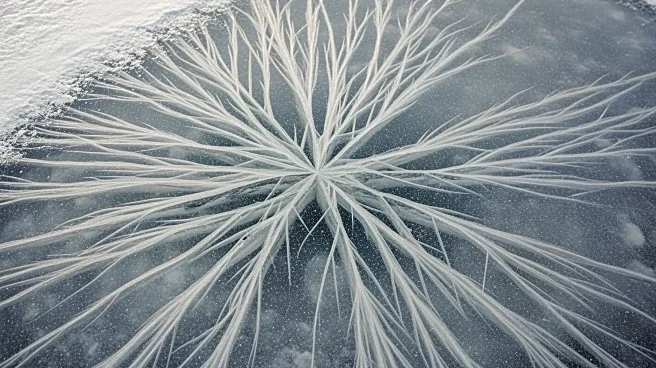
erupting through Europa's icy shell. The study, published in The Planetary Science Journal, suggests that these features could indicate the presence of brine pools beneath the surface. The research draws parallels between Damhán Alla and similar formations on Earth known as lake stars, which form when snow on a frozen lake melts in radial patterns due to underlying water. The discovery was initially made by NASA's Galileo mission, which conducted 11 flybys of Europa between 1989 and 2003.
Why It's Important?
The discovery of Damhán Alla on Europa is significant as it provides insights into the moon's subsurface conditions, potentially indicating the presence of a saltwater ocean beneath its icy exterior. Europa is considered one of the most promising locations for finding extraterrestrial life within our solar system due to its suspected subsurface ocean. Understanding these surface features could help scientists learn more about the moon's geological activity and the potential for life. The findings could also guide future missions, such as NASA's Europa Clipper, in exploring these intriguing formations and assessing the habitability of Europa.
What's Next?
The next steps involve further analysis of Europa's surface features using data from upcoming missions like NASA's Europa Clipper, which aims to conduct detailed reconnaissance of the moon's ice shell and subsurface ocean. Scientists hope to identify more formations similar to Damhán Alla, which could provide additional evidence of water activity beneath the surface. These efforts will enhance our understanding of Europa's potential to support life and inform the design of future exploratory missions to icy moons in the solar system.
Beyond the Headlines
The study of Europa's surface features not only advances our knowledge of the moon itself but also contributes to the broader understanding of icy bodies in the solar system. The presence of dendritic patterns similar to those on Earth suggests that similar geological processes may occur on other icy worlds, potentially expanding the scope of astrobiological research. This discovery underscores the importance of comparative planetology in uncovering the mysteries of our solar system and beyond.