
What's Happening?
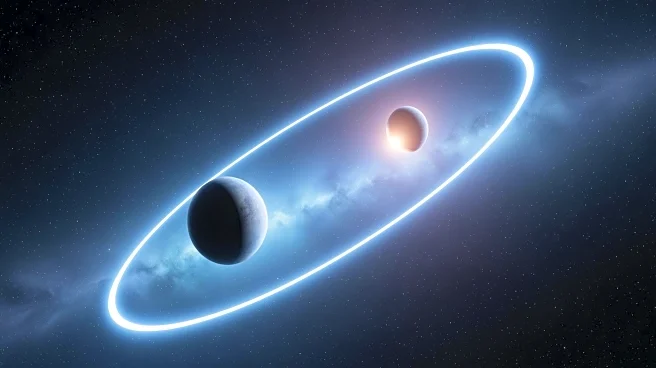
Scientists have discovered the first robust evidence of a black hole and neutron star merging while orbiting in an oval path, challenging previous assumptions about such cosmic events. The research, conducted by teams from the University of Birmingham,
Universidad Autónoma de Madrid, and Max Planck Institute for Gravitational Physics, was published in The Astrophysical Journal Letters. The gravitational-wave event GW200105 revealed that the system traveled on an oval orbit before merging, a phenomenon not previously observed. This discovery suggests that the system was influenced by gravitational interactions with other stars or a third companion, rather than evolving in isolation.
Why It's Important?
This discovery is significant as it challenges the prevailing view that neutron star-black hole mergers occur in circular orbits. The findings suggest that these systems may form in environments with complex gravitational interactions, leading to diverse evolutionary paths. This has implications for our understanding of how such cosmic pairs form and evolve, potentially requiring revisions to existing theoretical models. The research also highlights the need for more advanced waveform models to capture the complexity of these systems, which could lead to new insights into the formation and evolution of compact-binary mergers.
What's Next?
The study opens the door to further research into the diversity of neutron star-black hole mergers. Scientists may focus on identifying other systems with similar characteristics and exploring the environments in which they form. This could involve using advanced gravitational-wave detectors and developing new models to better understand the dynamics of these systems. As the number of gravitational-wave detections increases, researchers will have more opportunities to study unusual pathways and refine their understanding of cosmic mergers.